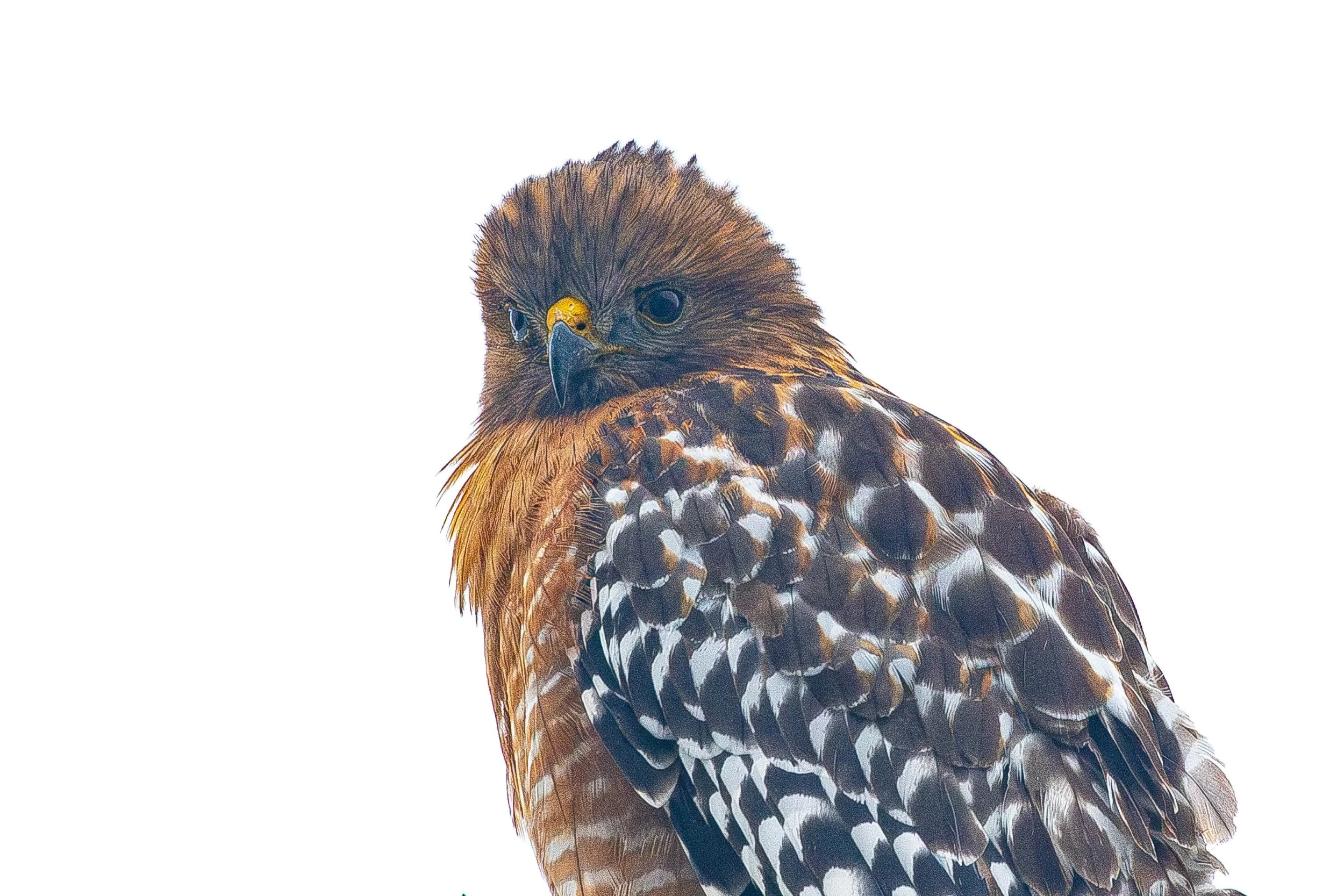
Red-shouldered Hawk © Larry Hickey
This month, let’s learn about a magnificent raptor in the Buteo genus called the Red-shouldered Hawk (Buteo lineatus). Red-shouldered Hawks are found only in North America and inhabit several states in the U.S.; a small area in south-eastern Canada; and in Mexico, where the Canadian and the northern-most populations in the U.S. spend their winters. Most Red-shouldered Hawks are permanent residents of the areas they inhabit. Migration is necessary for far-northern populations since less food is available in colder months and hunting becomes difficult due to snow and freezing temperatures. Here in the Sacramento Valley, Red-shouldered Hawks are year-round residents and are fairly common.
What do Red-shouldered Hawks look like?
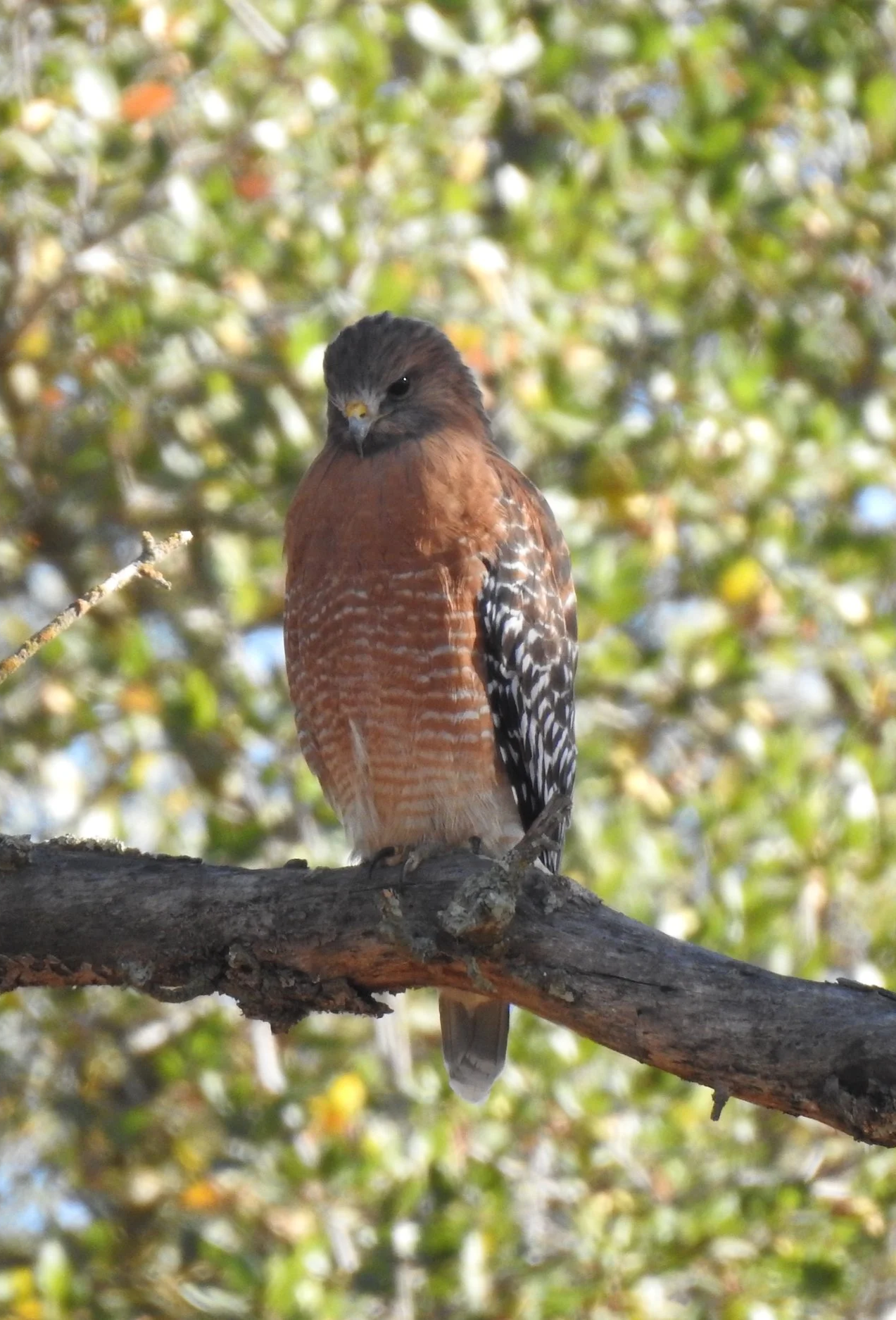
Red-shouldered Hawk © Mary Forrestal
Red-shouldered Hawks are slightly smaller than most of the other North American Buteo species. Male and female birds look similar but females are larger and heavier.
Five subspecies of Red-shouldered Hawks have been identified. The subspecies differ in size, darkness of chest barring, and/or head color. Birds of northeastern populations are often larger than those in the west and south, and birds found in Florida have paler plumage. The single western subspecies range ends west of the Sierra Nevada and is, therefore, separated from the other four eastern subspecies by 1,000 miles or more.
Red-shouldered Hawks have a dramatic feather pattern and coloration (plumage) which makes them quite eye-catching. Their wings have a striking black-and-white checkerboard pattern. Here in California, where the elegans subspecies is seen, Red-shouldered Hawks often have brown or reddish-brown heads; brown backs with white mottling; dark rufous (cinnamon) shoulders that are visible when perched; solid orange-rufous chests; broad, rounded, fingered wings having orange-rufous underwing linings that are visible in flight; reddish-brown horizontal stripes on their bellies; and yellow legs. The pattern of their tail feathers has alternating wide black bands with narrow white bands. There are several alternating black and white bands on their flight feathers as well. Some sources describe Red-shouldered Hawks’ tails to be longer than the tails of most other Buteos. Juveniles in the west resemble adult birds, but their chests lack the solid rufous color that adults have. Their chests are white and rufous-brown; streakier; spottier; and more heavily barred than adult birds.

Red-shouldered Hawk © Craig Swolgaard
In flight, a key ID point to look for are the white translucent, crescent-shaped (or square-shaped) patches, often called “windows”, that are present on the outer part of Red-shouldered Hawks’ wings. Seeing these patches often helps to identify the species and can be noticed even when a hawk is flying in the distance. It is often useful to look at the flight pattern of raptors to identify them. Red-shouldered Hawks use a few different flight patterns. They may fly directly to a close spot; or fly for longer durations using a repeated pattern of quick flaps changing to a glide; or soar high with their wings and tails fully spread and their wings slightly positioned forward. Males can be seen performing a courtship “sky-dance” which is described as a sudden dive from a high point followed by spirals and then rapid ascent. While calling loudly during flight, courting pairs will soar together making broad circles or will dive toward one another.
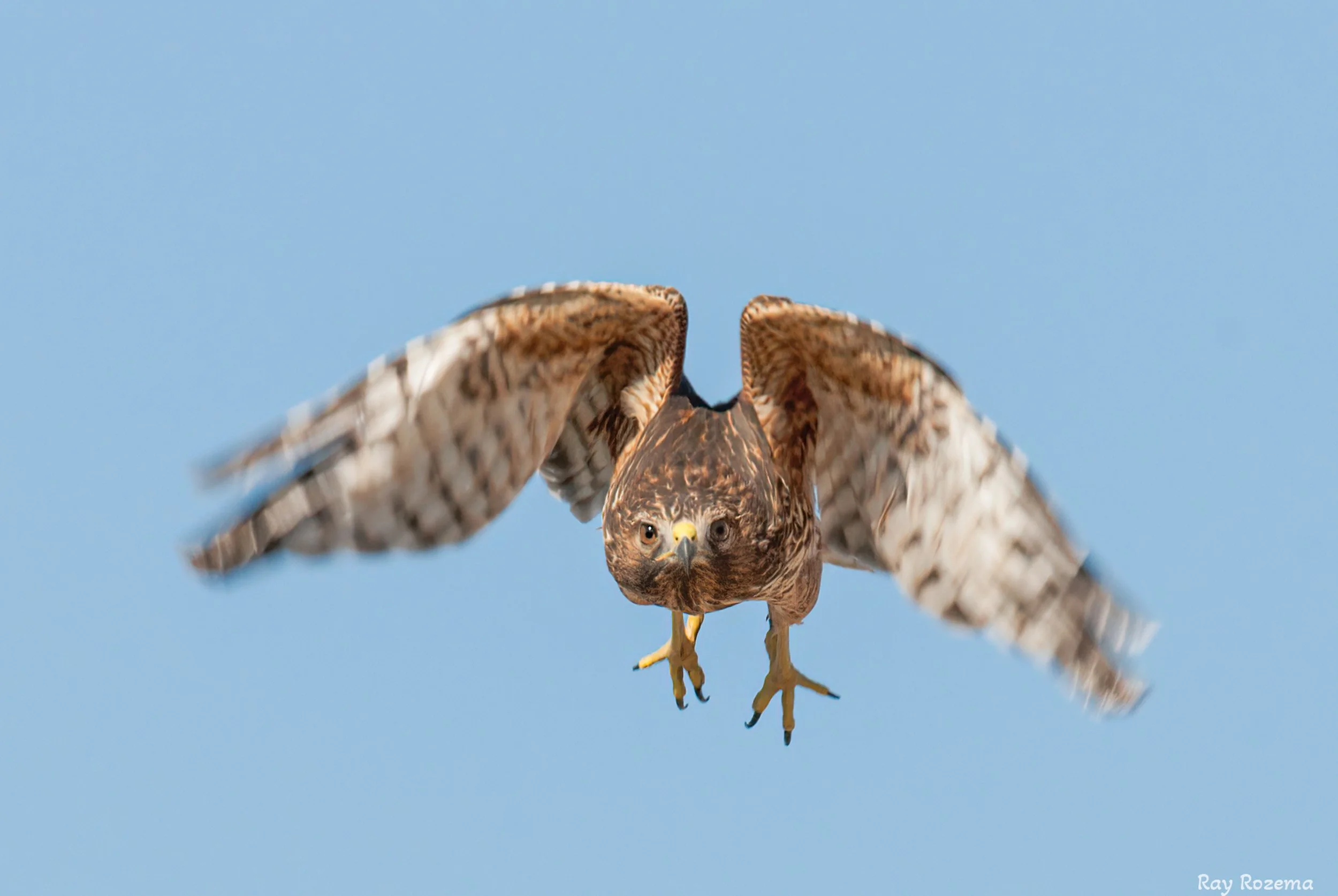
Red-shouldered Hawk in flight © Ray Rozema
Where do Red-shouldered Hawks live and nest?
Red-shouldered Hawks are found in a variety of habitats. They are seen in forests with clearings, oak woodlands, eucalyptus groves, lightly wooded foothills, near rivers, streams, creeks, other waterways, agricultural lands, and in suburbs and city parks that have abundant trees.

Red-shouldered Hawk © Larry Hickey
Pairs bond together for life. They are both extremely territorial and protective of their chosen territory.
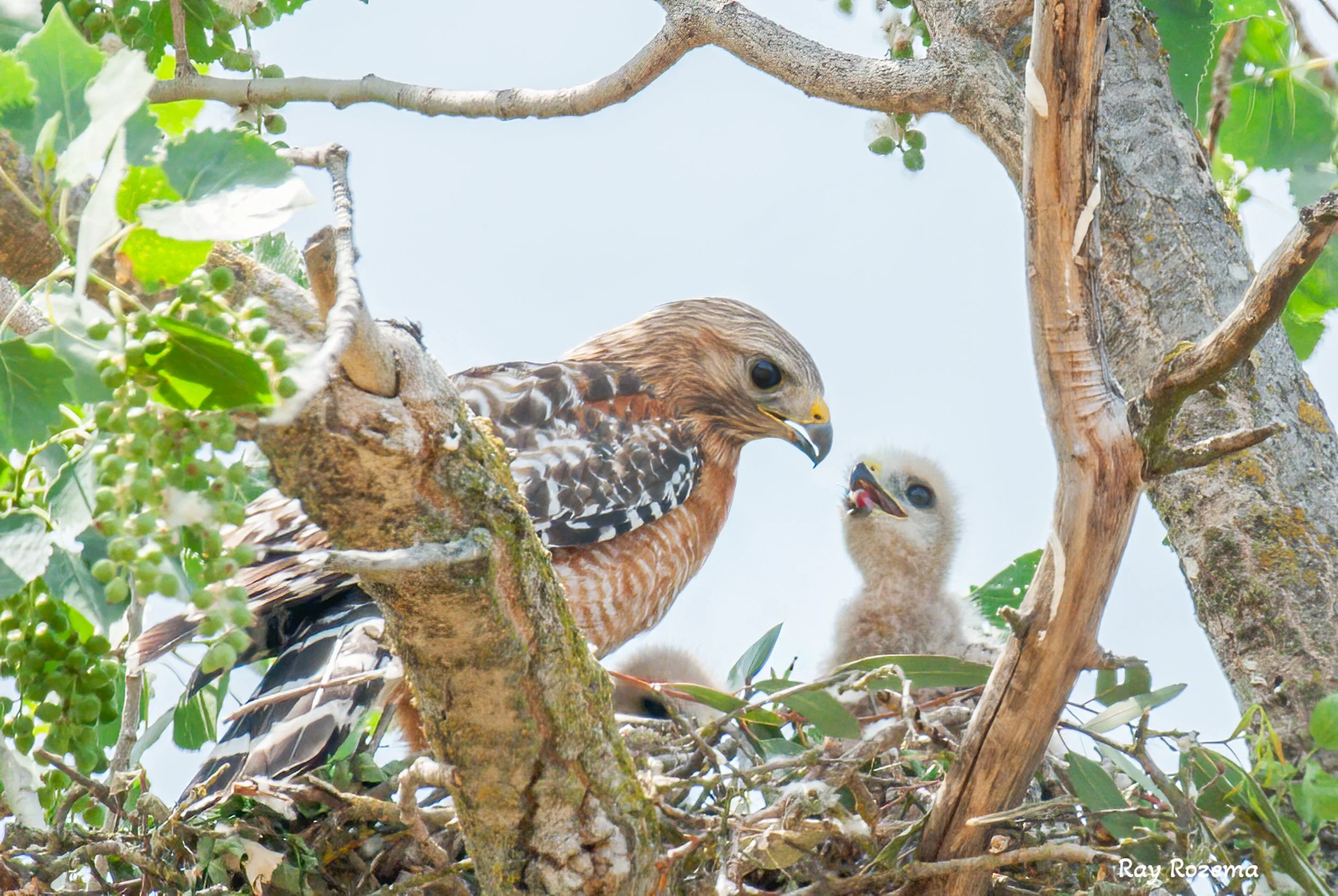
Red-shouldered Hawks, adult with nestling © Ray Rozema
Both male and female Red-shouldered Hawks participate in nest construction. In late winter or early spring, pairs often refurbish the same platform-style nest from year to year. Nests are 20-65 feet above the ground and often located in broad-leafed trees near the trunk and below the canopy. Occasionally, Red-shouldered Hawks will nest in conifers. Nest locations are usually near a body of water but they are also seen in trees in suburban neighborhoods or parks. Nests are about two feet in diameter and are constructed from sticks and lined with lichen, moss, shredded bark, and conifer sprigs. A pair has one clutch per year and the female usually lays 3-4 eggs. While it’s mainly the female that incubates the eggs for approximately 1 month, the male brings food to the female. Eggs hatch on sequential days, with the first chick hatching up to a week before the last. For several weeks after the eggs hatch, the female remains on the nest with the nestlings. The male continues to bring food to the nest. The young birds leave the nest at around 6 weeks old. However, the parents continue to feed them for another 8-10 weeks. The young birds become independent when they are 4 months old, but they still may roost close to the nest at night.
What do Red-shouldered Hawks eat?
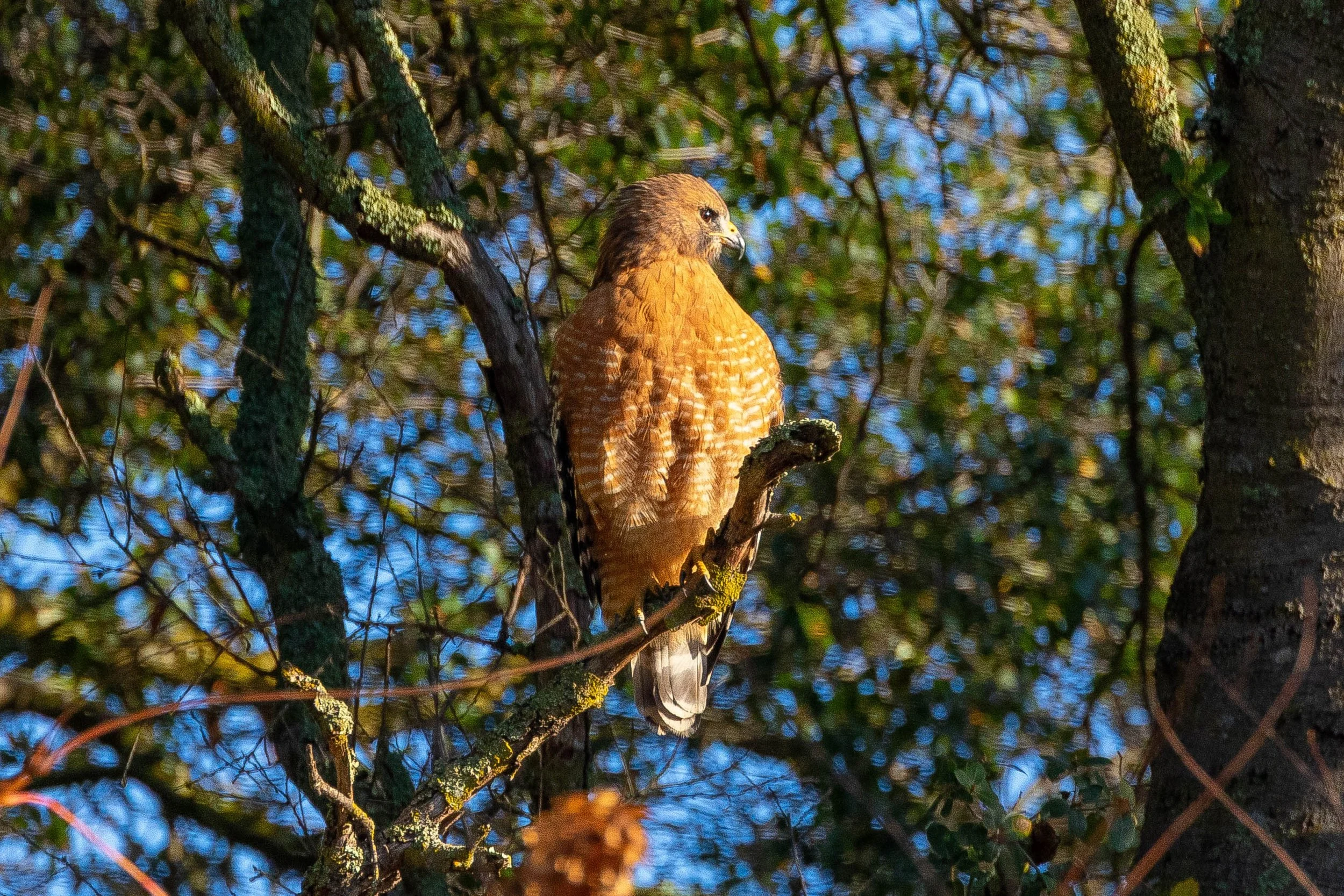
Red-shouldered Hawk © Larry Hickey
Red-shouldered Hawks are superb hunters due to their powerful talons and great vision. Their diet is dependent on the region where they live and the food that is available. Their broad wings allow them to soar looking for prey for long periods of time without tiring. Red-shouldered Hawks hunt while perched in a tree (often at mid-level) or while perched away from trees in a clearing, perhaps on a utility wire or post. They sit silently, patiently, and still until they see prey appear below. Then they descend swiftly, gliding and snatching an animal off the ground. They also look for prey while flying low and will surprise prey by directly landing on top of them.
Small mammals, such as mice, voles, and chipmunks are typically the most common prey of Red-shouldered Hawks. Red-shouldered Hawks are an important part of our ecosystem because they keep rodent populations in check benefiting agricultural, natural, and residential areas alike. They will occasionally eat larger mammals, such as opossum, rabbits, or squirrels and help normalize these populations too. In addition, Red-shouldered Hawks eat snakes, lizards, frogs, crayfish, large insects, and earthworms. Occasionally, they will eat birds or fish.
What do Red-shouldered Hawks sound like?

Red-shouldered Hawk © Daniel Lee Brown
Red-tailed Hawks are often heard calling before they are seen. Their call typically is a two-syllable scream. Female vocalizations are noticeably lower pitched than those of males.
Red-shouldered Hawk calls have been described as falling, squealing, mournful, distinctive, deliberate, simple, sharp, chattering, and shrill. Their calls usually have downward inflection or pitch and are often repeated over and over. They have been described as sounding like: kee yah; kee yuur; kee yar; kee-aahh; or kee yeeear. Calls are heard most often in the spring and summer, often made by birds in flight. The common call kee aah is used to announce that a particuliar area is occupied or to sound an alarm.
You can listen to the calls of the Red-shouldered Hawk below:
This article was compiled by Jane Van Kessel.
Sources include Animal Diversity Web, University of Michigan; Cornell’s All About Birds; Cornell’s Birds of the World; National Audubon Society’s Online Field Guide; 150 Frequently Seen Birds of California’s Great Valley, pages 140-1; Wikipedia; National Geographic Field Guide to the Birds of the United States and Canada West, 2nd Edition, pages 224-5; The Sibley Field Guide to Birds of Western North America (Sibley Birds West) by David Allen Sibley, page 102; Kaufman Field Guide to Birds of North America by Kenn Kaufman, pages 112-13; The Stokes Field Guide to the Birds of North America by Donald & Lillian Stokes, 2010, pages 164-5; Peterson Field Guide to Birds of Western North America by Roger Tory Peterson, Fifth Edition, pages 188-9.
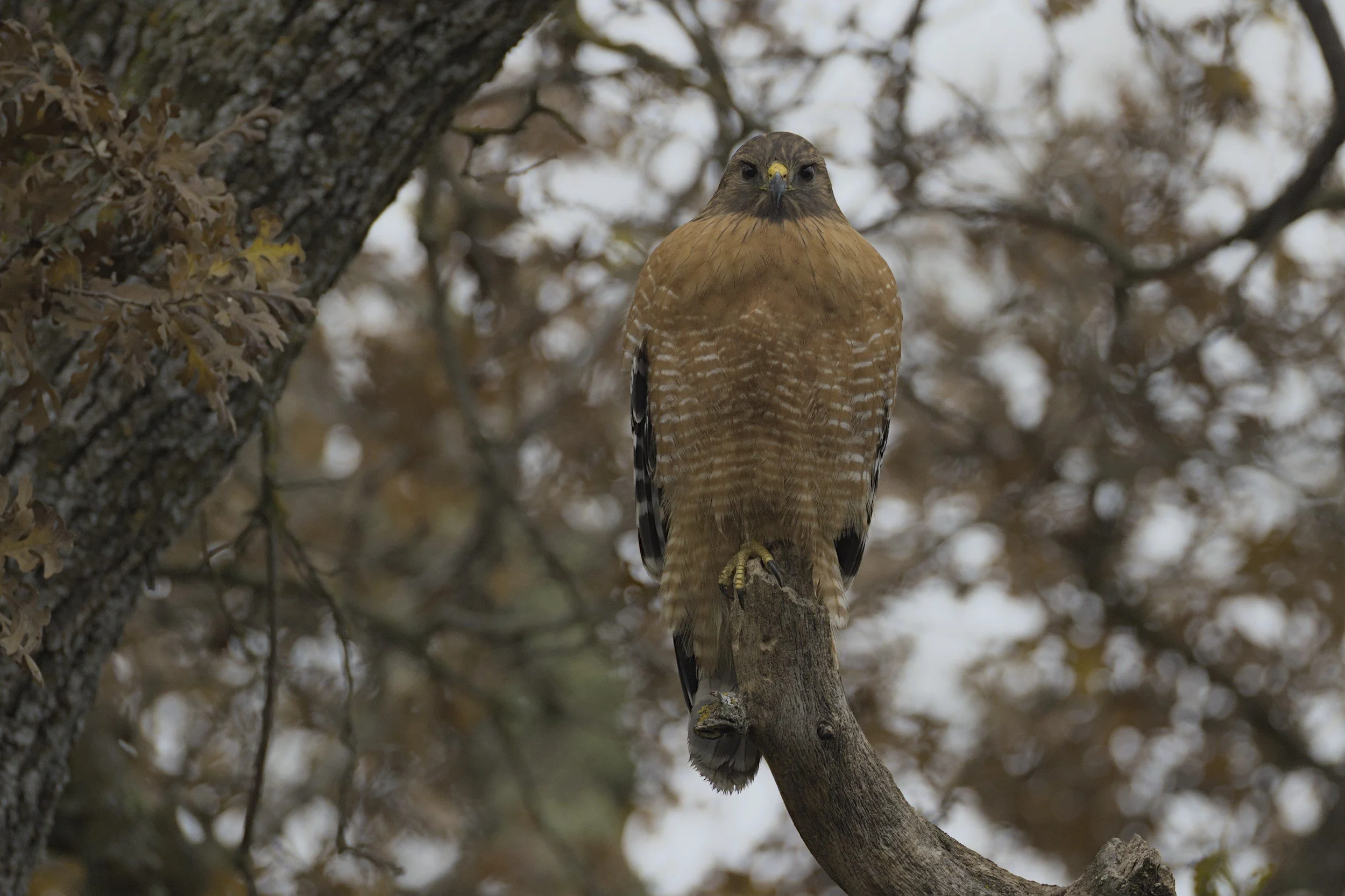
Red-shouldered Hawk © Timothy Jackson