
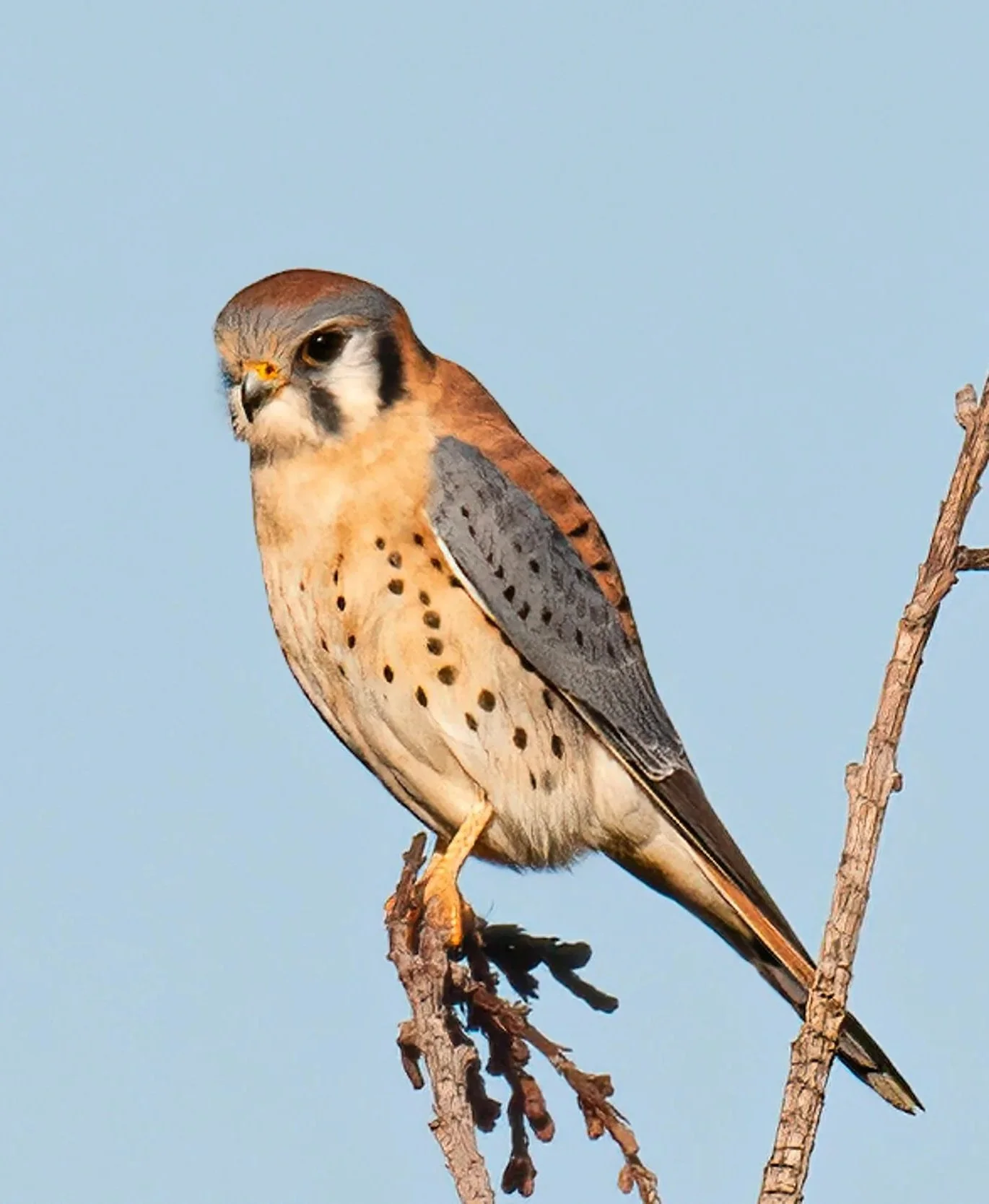
American Kestrel, male © Ray Rozema
This month, let’s learn about a colorful and common falcon in North America called the American Kestrel (Falco sparverius). American Kestrels are small raptors. However, even with their small size, they can be quite bold. They will attack Golden Eagles if necessary to defend their territory.
American Kestrels are widespread throughout the Americas from the boreal forests in Canada and Alaska to the southern tip of Argentina. Breeding populations in the north migrate for long distances in both spring and fall; whereas those that nest in southern regions usually do not migrate. In the fall, birds nesting in northern regions migrate to the southern United States, Mexico, Central America, or the Caribbean and then return to the north in the spring to breed once again. Migrating birds usually migrate alone.
In the past, American Kestrels were called “Sparrow Hawks” by some. The name is inaccurate for two reasons. First, American Kestrels are true falcons, not hawks. Second, sparrows and other small birds are seldom part of their diet.
The American Kestrel population has been declining across North America for many years. Their current number is about half of what it was in 1960. The primary reason for the decline is thought to be a lack of nest sites due to habitat change and conflicts (or nest site competition) with other species. One invasive species, the European Starling, has had a very negative impact. Another theory looks at increased use of insecticides, which dramatically decreases the amount of available prey. More significantly ingesting pesticides can also harm and even kill the kestrels.
What do American Kestrels look like?
American Kestrels are about the same size as a Mourning Dove or an American Crow. They are leaner and less muscular than the other falcons seen in the Sacramento Valley. American Kestrels have long tails with squared tips; narrow, pointed, and strongly tapered (or sickle-shaped) wings; and have rusty or rufous caps or head patches. The underside of their wings are white or cream with thin dark barring. While most other area falcons have a single vertical dark cheek stripe, American Kestrels have two stripes on their white cheeks. In addition, they have two large dark spots (or bars) on the back of their necks called ocelli. Researchers think these spots may act as “false eyes” and can actually deter predators. A predator may think a kestrel is facing them when actually it is in a more vulnerable position facing away.
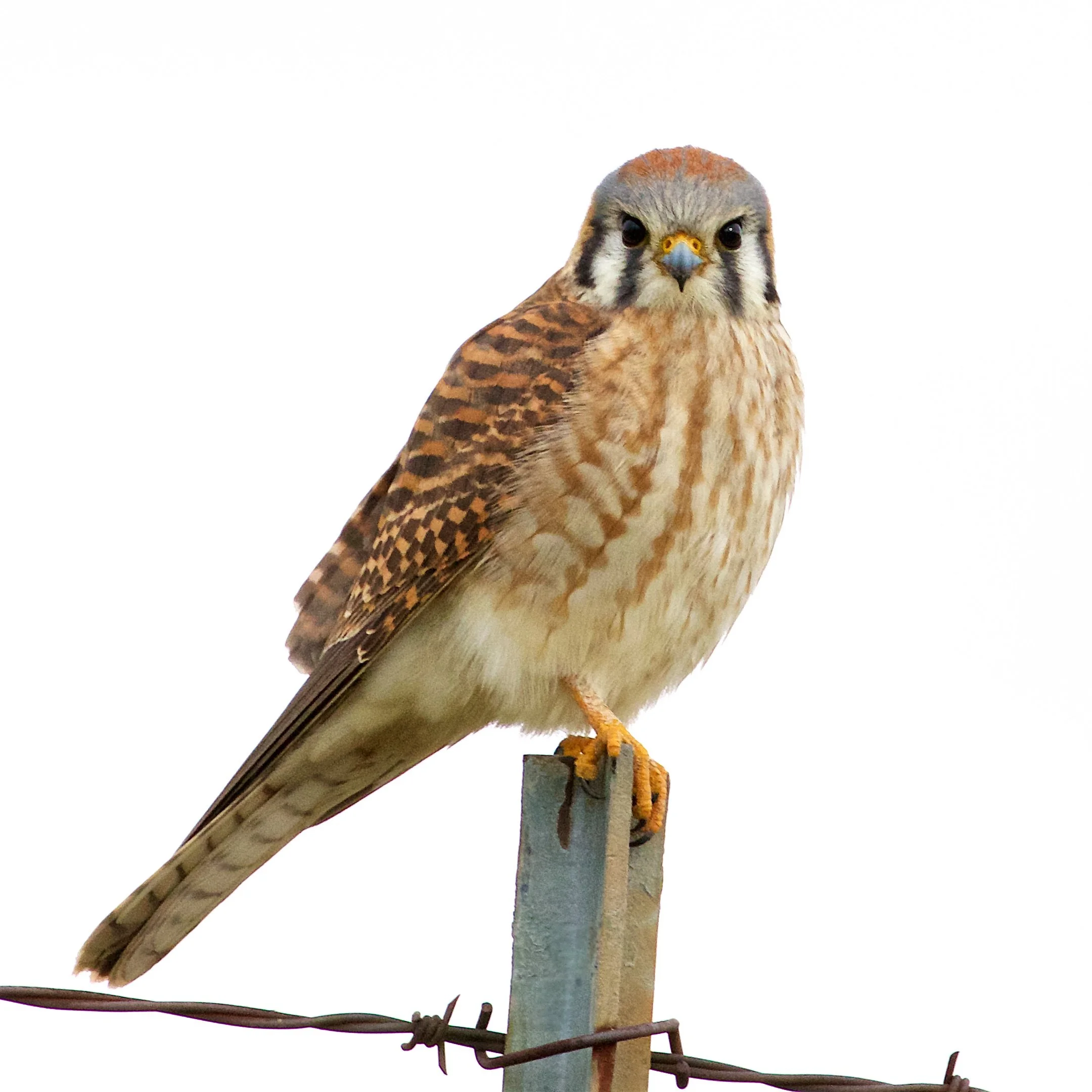
American Kestrel, female © Ed Harper
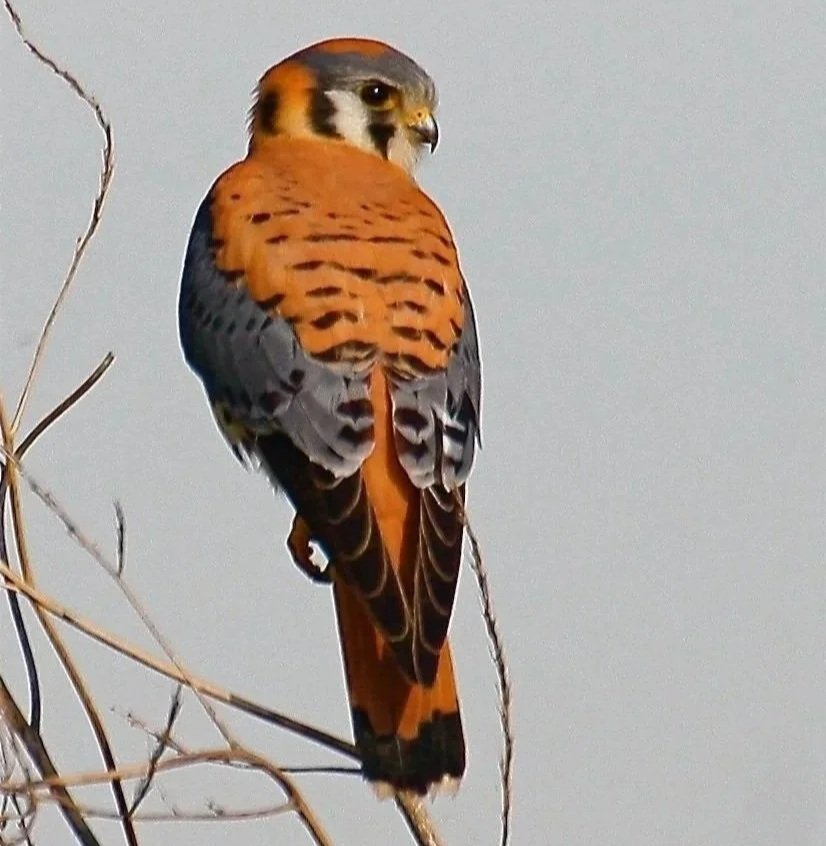
American Kestrel, male © Ed Harper
American Kestrels are unique because, unlike most raptors, the plumage of the male and female is noticeably different. This plumage difference is called sexual dimorphism.
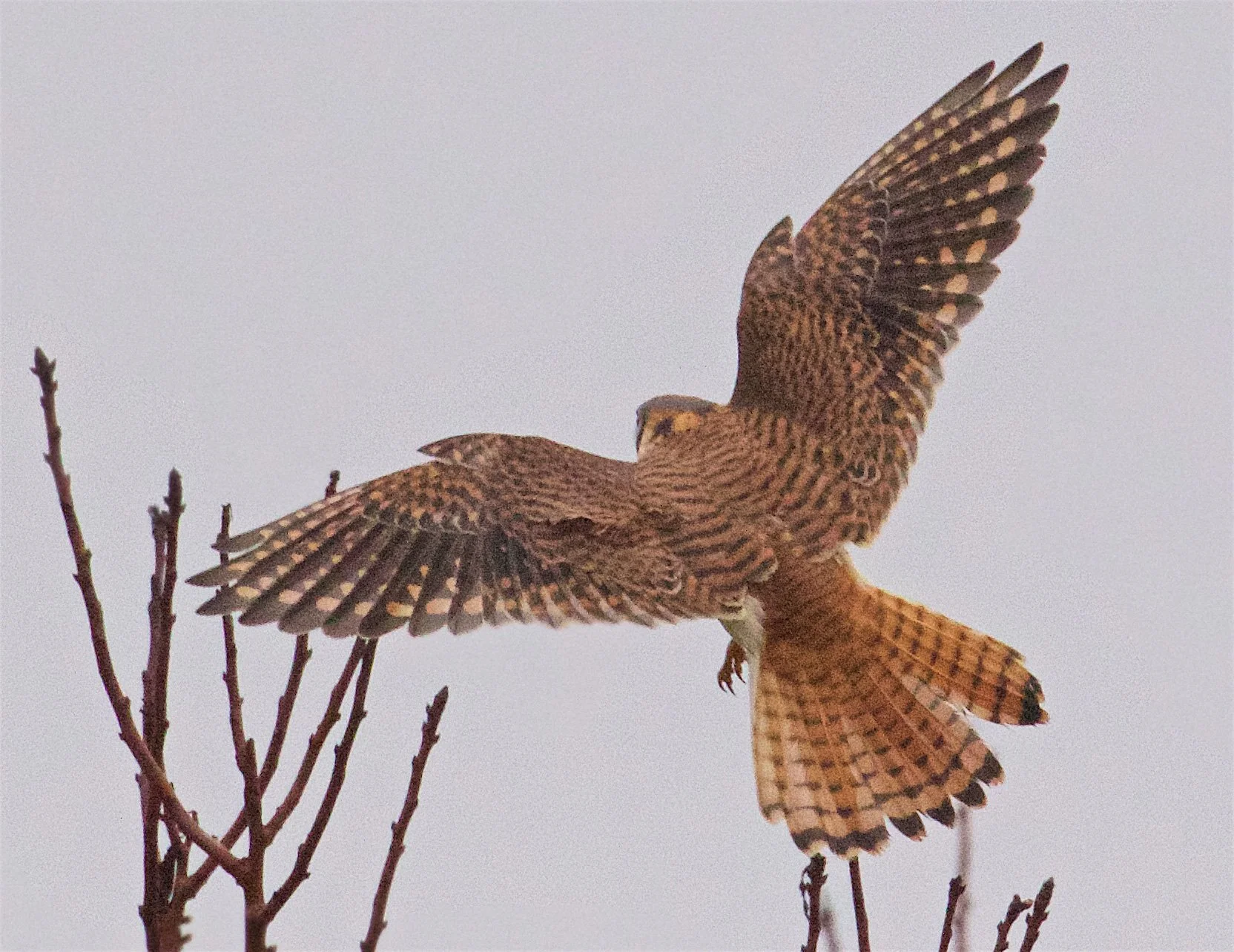
American Kestrel, female © Ed Harper
American Kestrel females have rusty-brown backs, wings, and tails which are completely barred or striped. They often have heavy brown streaking on their chests and abdomens too. The heads of females are gray or bluish-gray and they usually have a duller (or blended) rufous crown patch.
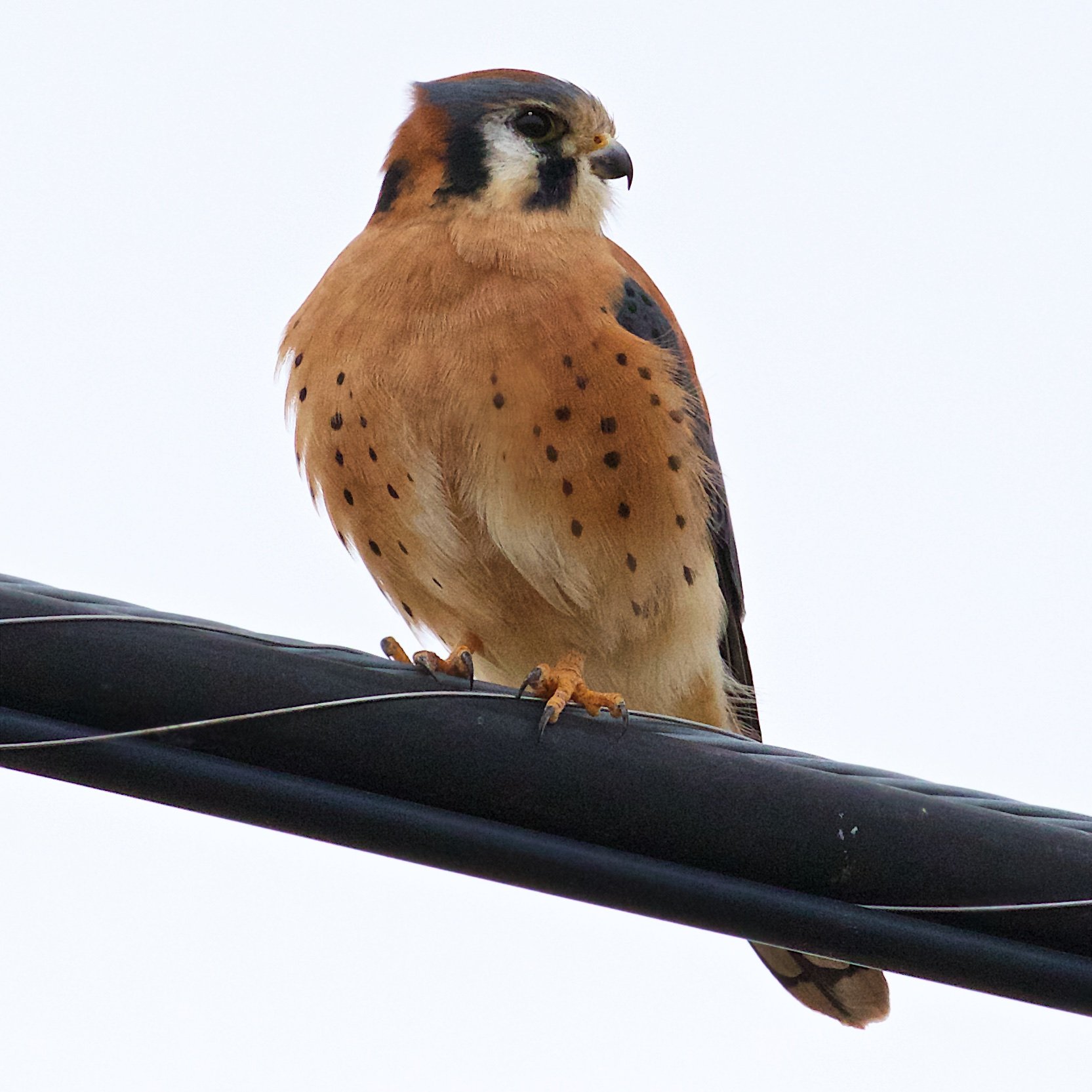
American Kestrel, male © Ed Harper
American Kestrel males are slightly smaller than females but are more colorful. They have deep slate-blue heads and upper wings which contrast beautifully with their deep rufous-red backs and tails. Males lack the barring on their backs and tails that females have. They also have a wide black band at the tip of their tails, which isn’t present on females. Males have scattered black spots, instead of streaks, on their backs, wings, flanks, and abdomens. The underside of males is more colorful than females and is quite variable from light to dark orange along with buff lower down. However, it’s easiest to distinguish between female and male American Kestrels by simply comparing their wings and tails.
Juvenile American Kestrels are similar in appearance to adults of the same sex. Although it can take up to two years for juveniles to exhibit complete adult plumage, the sex of a bird can often be identified early on, even before it’s time to fledge.
The flight pattern can also be used to help identify an American Kestrels as it is different from that of other falcons found in California. American Kestrels fly with erratic and fluttery wingbeats compared to the more powerful wingbeats of Peregrine Falcons, Prairie Falcons, and Merlins. In direct flight, American Kestrels hold their wings bent backwards making a “drawn bow” silhouette in the sky.
Where do American Kestrels live and nest?
American Kestrels live in diverse conditions throughout their range. They favor open habitat near fields, desert grasslands, farmland dotted with trees and snags, meadows or pastures, parklands, woodland edges, deserts, and along suburban or urban roadsides near residential areas. They remain where they can find adequate prey and have access to raised perches used to hunt. Open or semi-open terrain is critical for kestrels to spot their prey. When looking for prey, they are often seen alone and perched on utility lines, fence posts, or in bare tree tops along roadsides where there is low vegetation and few trees. However, during the breeding season they are limited to habitats that offer nest sites.
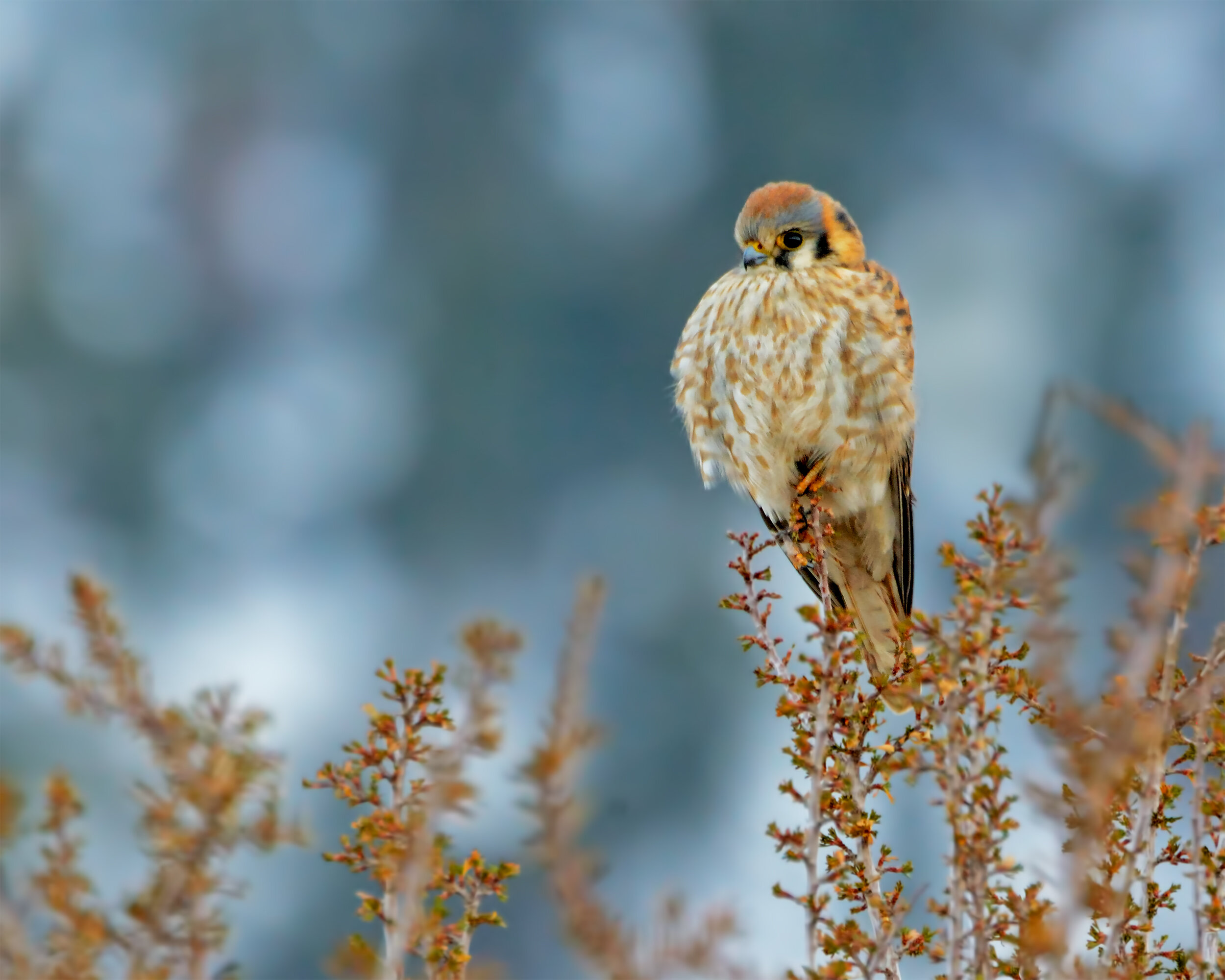
American Kestrel, female © Daniel Lee Brown
American Kestrels are cavity nesters but they do not have the ability to create their own cavities. They either need to find an unused cavity or evict the current residents. They generally prefer natural cavities (such as in hollowed trees) that have closed tops and tight-fitting entrances. These features provide good protection for their eggs and young. However, American Kestrels will settle for less desirable places to nest. They adapt to a wide range of nesting situations and will nest in nooks or crevices that are either natural or human-made. Occasionally, they will use abandoned nests in trees and will also nest on cliff ledges, rocks, and on tops of buildings. Nest sites are usually 10-30 ft above ground but can be found at any height. In the southwest, they often nest inside holes found in giant cacti.
American Kestrels will readily accept manmade nest boxes. Despite the fact that American Kestrels are the most abundant falcon in the U.S., they are in decline and struggling. In an attempt to help, over a thousand boxes have been set up across the U.S. and many nesting pairs have used them. Some boxes have hosted kestrel families for decades. Homeowners and scientists alike have set up nest boxes to provide nesting sites. Here is a link with instructions and tips from Cornell Lab’s NestWatch on constructing kestrel nest boxes: American Kestrel Nest Box. In some areas, artificial nest boxes have enabled kestrels to increase in number and have helped populations thrive in formerly unused locations.
Males locate nest sites and will entice females to come evaluate a site by using food. Females make the final decision on whether a site is acceptable or not. American Kestrel pairs often stay together for several years or permanently. They usually raise one brood per year but females will lay replacement clutches if their first clutch is lost early on. Females often create a depression or “scrape” in the floor of a cavity before laying eggs and then lay three to seven eggs. Incubation lasts around 30 days and is done mostly by females. According to one site, males help with incubation about 15-20% of the time. Egg hatching takes place over three to four days. Hatchlings are totally dependent on their parents for food and warmth and are able to sit up after the fifth day of life. The female cares for the nestlings continuously until they are about nine days old. The growing nestlings can eat twice as much food in a day as an adult bird! These tiny nestlings eat 2 to 3 mice or voles a day and grow rapidly, reaching adult weight in a little over two weeks. The males hunt and provide food for both the female and young until the young are two weeks old. After that, both parents supply food to their young and begin to leave intact prey in the nest. After 28–31 days, the young birds’ wings are fully developed and they are able to fledge or fly from the nest. Young fledglings depend on their parents for food for two to three weeks after leaving the nest. During this time, the young sometimes return to the nest cavity to roost and to remain close to their siblings. Unlike some other species of birds, sibling kestrels are very tolerant of each other. Siblings often perch and fly together before leaving the area. When young kestrels first begin to hunt, they are accompanied by their parents. This gives the young birds an opportunity to become skilled hunters before they leave the area. The young will leave the area and become independent about 30 days after fledging. They sometimes will join a group of other young kestrels.
What do American Kestrels eat?
The diet of American Kestrels is comprised of many types of food. They mainly eat large insects. While their favorite insects are grasshoppers, American Kestrels also eat crickets, butterflies, moths, dragonflies, caterpillars, beetles, small mammals, crayfish, lizards, frogs, earthworms, spiders, and occasionally small birds and bats. Rarely, they will prey on animals larger than themselves, occasionally eating squirrels and snakes.
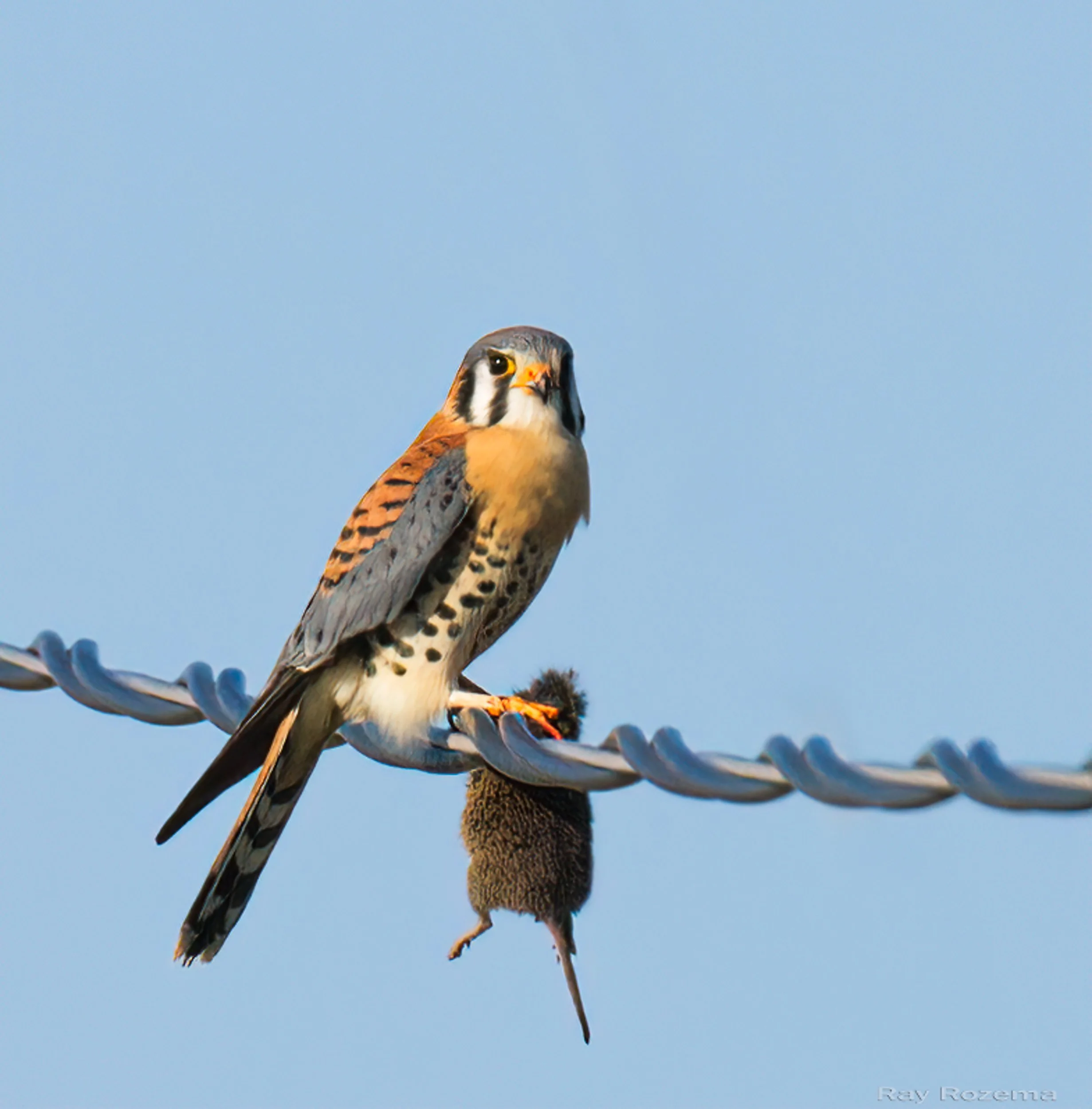
American Kestrel, male © Ray Rozema
American Kestrels prefer to hunt using an energy-conserving “sit and wait” tactic. They wait for prey to come near their perches, then they swoop down to the ground to make a capture. Kestrels are a common sight in rural areas, perched on utility poles. They need to be at a height where they can survey a large area and spot movement of potential prey. They may change perches a few times throughout the day. Before striking, kestrels characteristically bob their heads and tails.
If a secure perch is not readily available, American Kestrels will hover in the air to hunt. They are very skilled at hovering and can do so for along periods of time. While hovering, their heads remain completely still even in high wind, then suddenly they drop to the ground to grab prey.
Occasionally, American Kestrels will hunt for food when flying low over fields. Birds, in general, are able to see ultraviolet (UV) light. UV light makes the urine trails left by small animals glow bright yellow. This visual ability makes it easy for kestrels and other raptors to know where prey is likely to be.
American Kestrels are known to store or cache excess food. They will cache food in tree roots, in clumps of grass, tree limbs, bushes, fence posts, or in tree cavities. Caching is a common behavior among predators to ensure that they have access to food if there is a sudden lack of prey.
What do American Kestrels sound like?
American Kestrels can be extremely vocal and loud at times. Their calls have been described as klee klee klee klee or killy killy killy. Sometimes combinations of klee and killy are heard. In addition, American Kestrels have a whine-like call and a chitter call. The calls of juveniles are similar to those of adults. Listen the to calls of the American Kestrel below.
This article was compiled by Jane Van Kessel.
Sources include Cornell’s All About Birds; Cornell’s Birds of the World; National Audubon Society’s Online Field Guide; 150 Frequently Seen Birds of California’s Great Valley, pages 170-71; National Geographic Field Guide to the Birds of the United States and Canada West, 2nd Edition, pages 258-9; The Sibley Field Guide to Birds of Western North America (Sibley Birds West) by David Allen Sibley, page 258; Kaufman Field Guide to Birds of North America by Kenn Kaufman, pages 126-27; The Stokes Field Guide to the Birds of North America by Donald & Lillian Stokes, 2010, pages 184-85; Peterson Field Guide to Birds of Western North America by Roger Tory Peterson, Fifth Edition, pages 200-01.
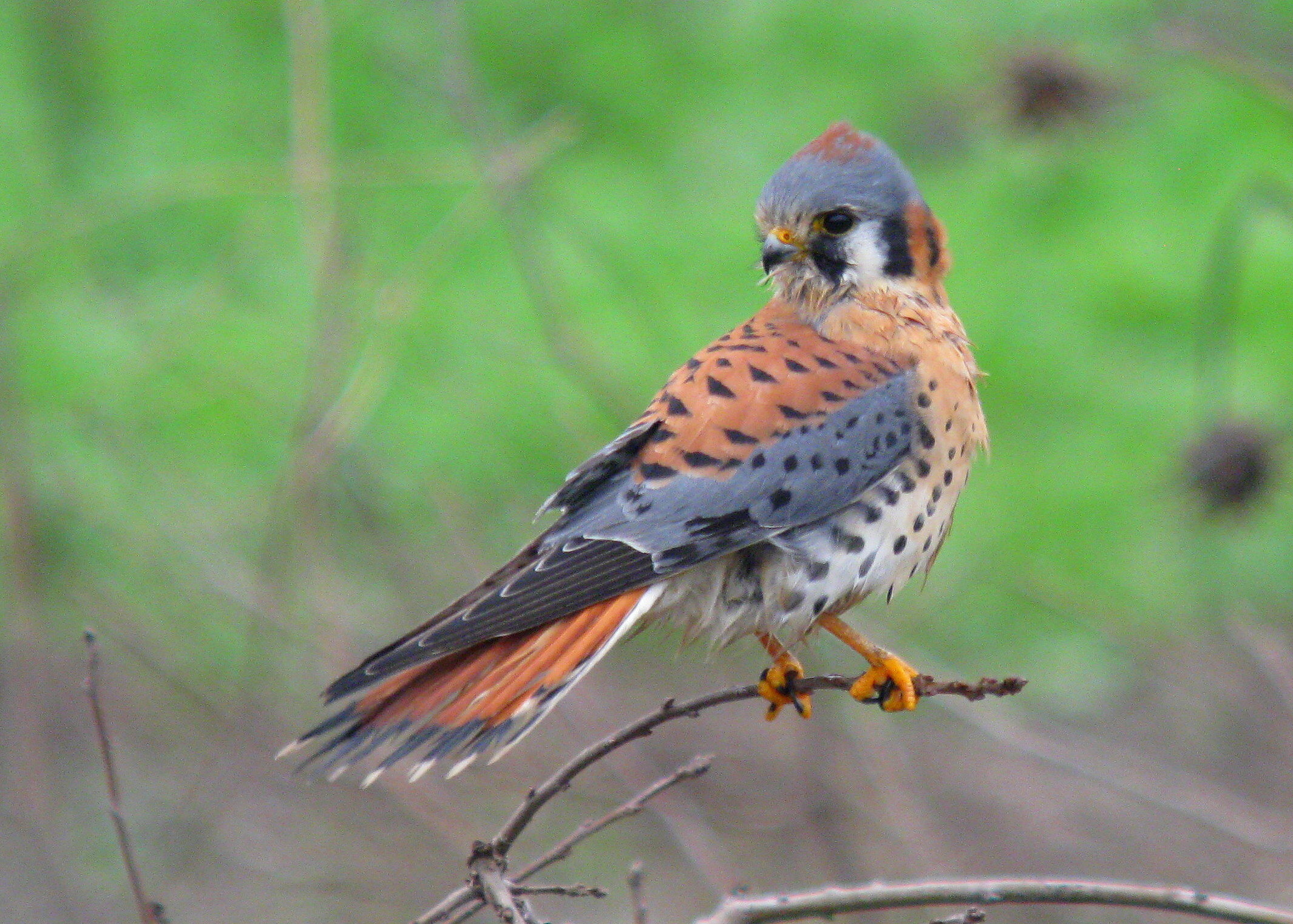
American Kestrel, male © Chris Conard