
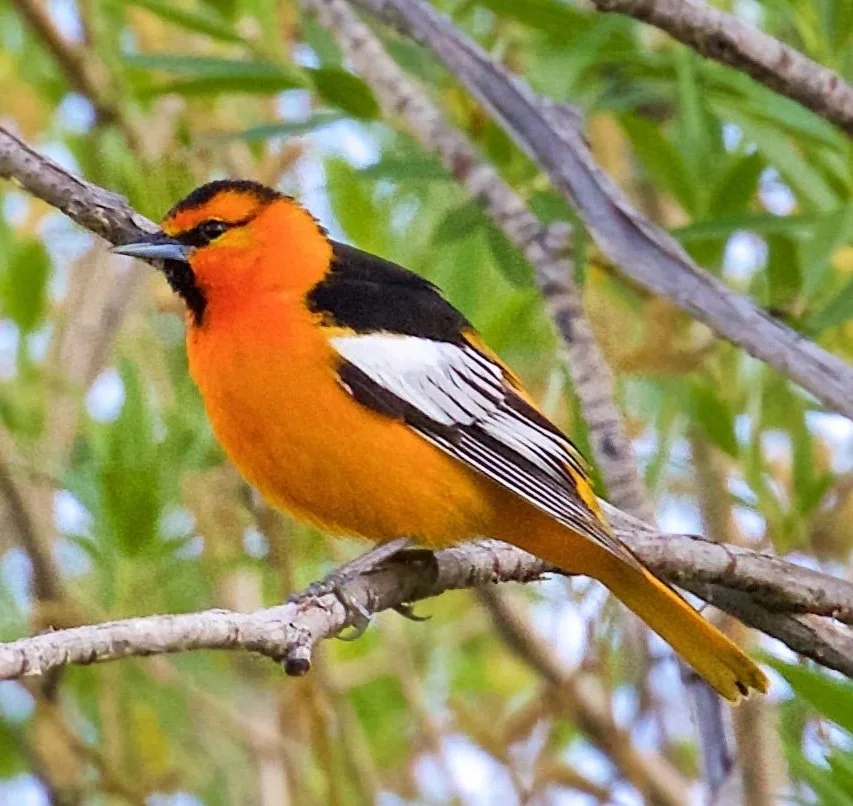
Adult male Bullock’s Oriole © Ed Harper
This month, let’s talk about an eye-catching, boldly-colored song bird called the Bullock’s Oriole (icterus bullockii). Bullock’s Orioles are “New World” orioles (those found in the Americas). They are related to New World blackbirds. Both orioles and blackbirds are in the same bird family (Icteridae), along with grackles, cowbirds, meadowlarks, and oropendolas. The 30 plus species of New World orioles are not closely related to “Old World” orioles found in Africa, Asia, and Europe.
The Bullock’s Oriole is the most common oriole species seen throughout the western United States. Of the 4 species that are usually found the in western U.S., Bullock’s Orioles nest further north and in the most western states. The species was named after English naturalists William Bullock and his son, who was also named William. Because this duo had collected a large amount of information on the species, the American Ornithologists’ Union wished to honor them.
From 1973 to 1995, Bullock’s Orioles and Baltimore Orioles were considered the same species and were called the Northern Oriole. The two species interbreed where their range overlaps near the western Great Plains. However, in 1995 after further DNA analysis and new data indicating that the area of interbreeding was not expanding, the two were once again classified as two separate species.
Bullock's Orioles are said to be Neotropical migrants because they breed in western North America and spend their winters primarily in tropical/subtropical regions. Their fall migration begins early, with many birds leaving northern breeding areas by the end of July. They migrate south in small, loose flocks at night from late July to September and return to their northern breeding grounds by late March to May.
What do Bullock’s Orioles look like?

Male Bullock’s Oriole © Daniel Lee Brown
Bullock’s Orioles are 17-19 cm long and have slender bodies, dark eyes, medium-long tails, and sharply pointed, black to bluish-gray bills, which are wide at the base. The lower part of the bill is lighter in color than the upper part.
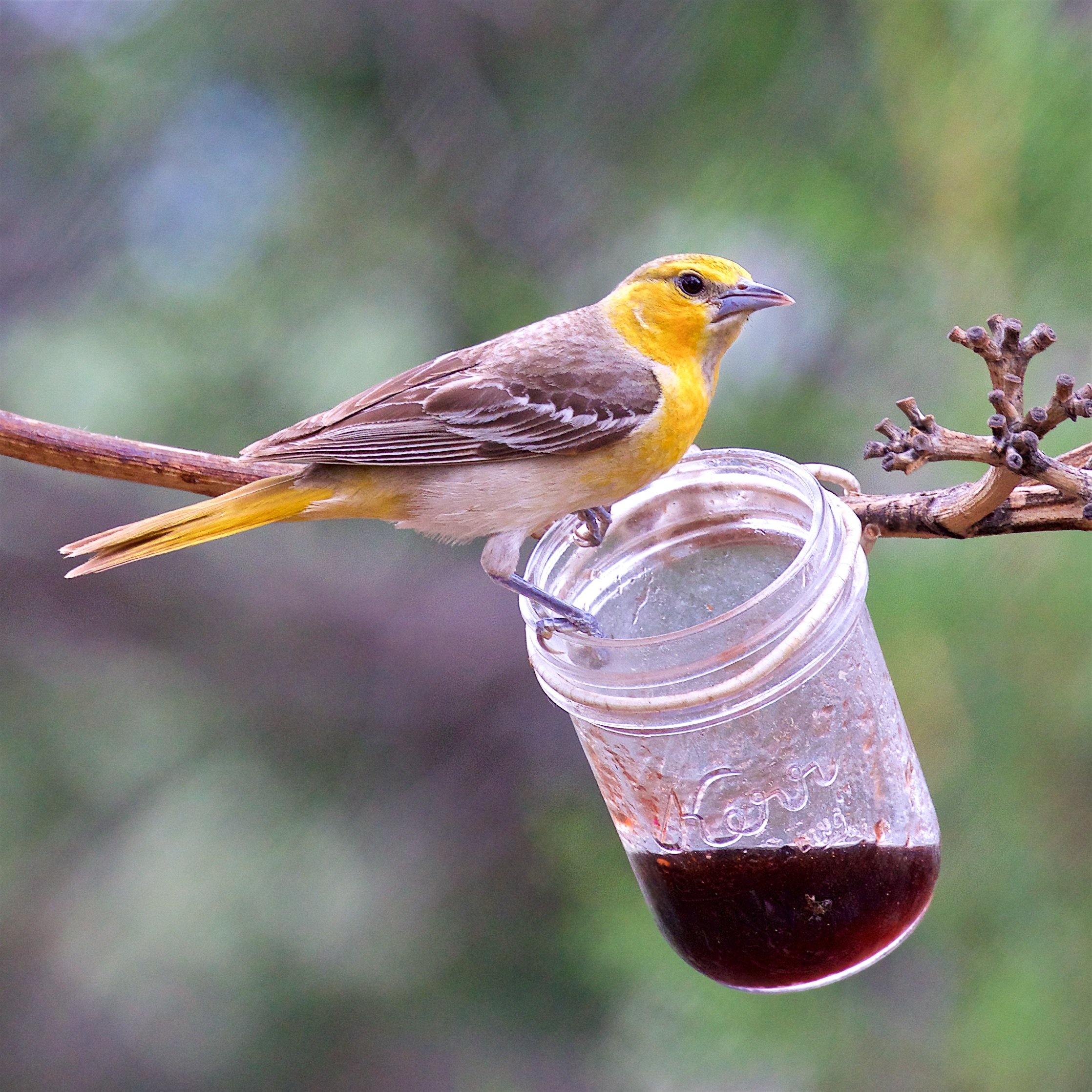
Female Bullock’s Oriole © Ed Harper
Adult male Bullock’s Orioles can be quite stunning. They are slightly larger than females and are considerably darker and brighter in color. Adult males are often a brilliant orange or yellow-orange and have a dark line running from their eyes to the back of their heads. Their range in color is thought to be somewhat diet related. Males have black crowns (the tops of their heads), black lores (the area between the eye and the bill), black backs and wings, large white wing patches, black throat patches, and black upper tails. In contrast, the faces, throats, chests, and tails of female Bullock’s Orioles are dull yellow or yellowish-orange. They have grayish-brown wings with white (sometimes yellowish) wing bars, whitish- or light gray bellies, grey-brown backs, and their crowns are olive-gray. Females lack dark eye lines (many photos suggest that a faint line is present), dark lores, wide wing patches, and usually the dark throat patches on males. However, sometimes older females have small black throat patches.
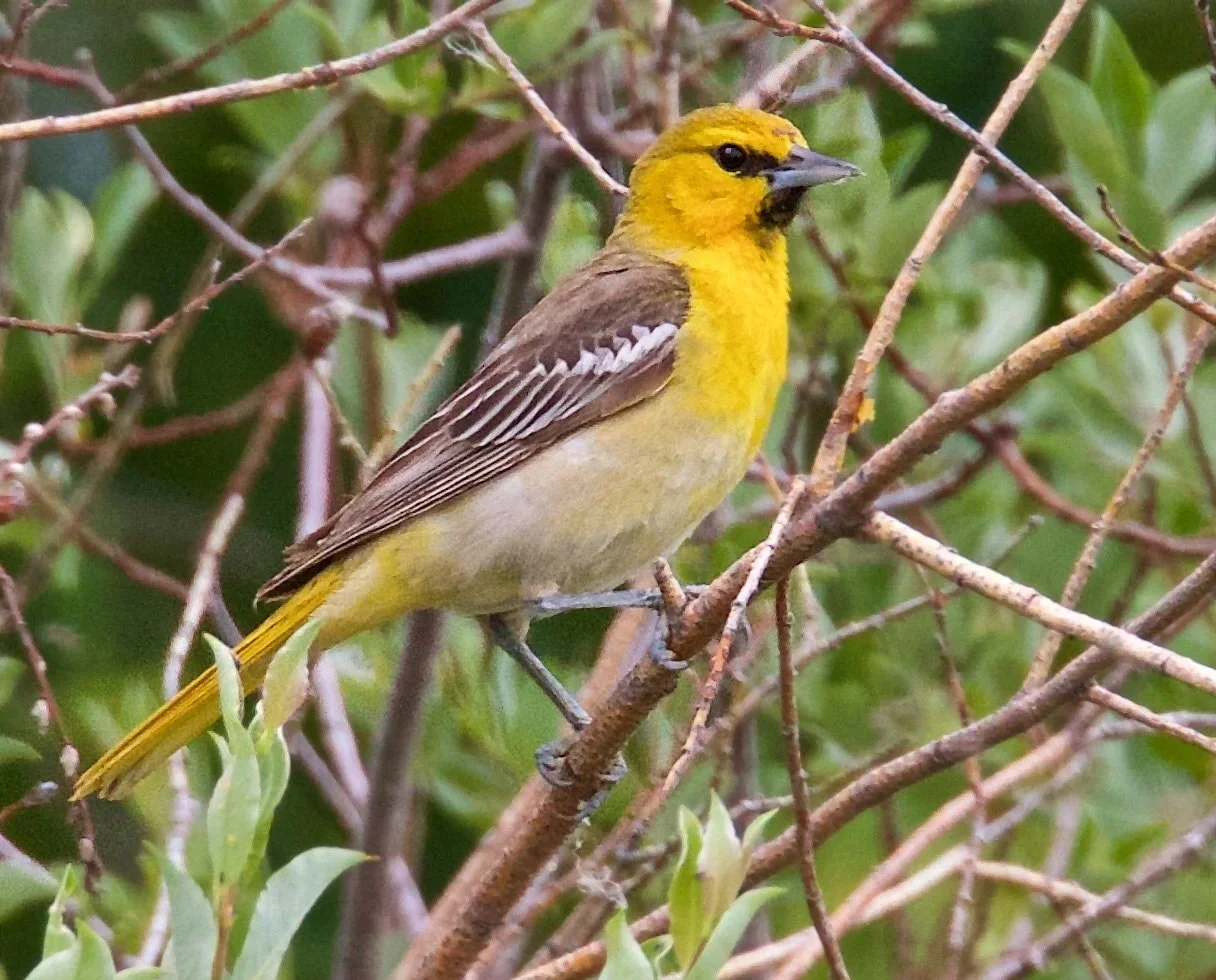
Immature male Bullock’s Oriole © Ed Harper
Male and female juvenile Bullock’s Orioles are similar. Juveniles resemble adult females but tend to have darker wings and have less-extensive wing bars. One may notice that many photographs of Bullock’s Orioles are captioned with “female/immature male”. Immature males frequently will have dark eye lines, lores, and some black on their throats, but only have faint black crowns.
FYI- Another oriole species, called the Hooded Oriole (icterus cucullatus), is also found in the Sacramento Valley region. Hooded Orioles have similar black and orange color but their bills are longer and have a more pronounced downwards curve. Their bodies are more slender, and their tails appear longer. Male Hooded Orioles differ from male Bullock’s Orioles because they lack a black crown, have narrow white wing bars (compared to the large white patches on male Bullock’s Orioles). Female Hooded Orioles are olive-yellow on both their chests and bellies; whereas female Bullock’s Orioles’ have yellow chests fading into light-gray bellies.
Where do Bullock’s Orioles live and nest?
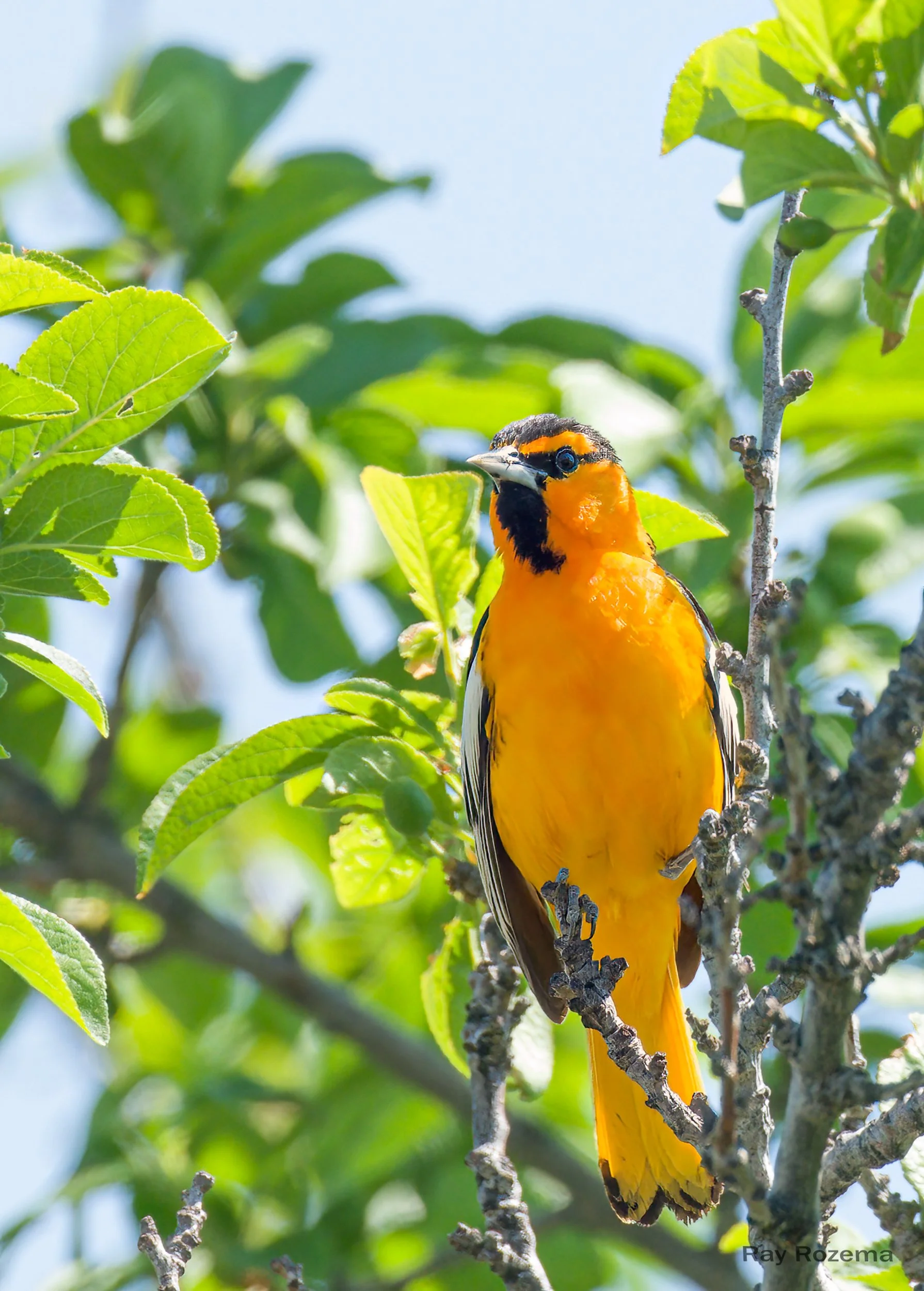
Adult male Bullock’s Oriole © Ray Rozema
In spring and summer, Bullock’s Orioles mainly nest in the western U.S., but also nest in southern Canada and northern Mexico. They prefer to nest in open deciduous woods with trees that offer them good canopy. Look for them in tall, forked, broadleaf trees, such as cottonwoods, live oaks, sycamores, maples, and willows that line streams and rivers. In other regions, they nest in pecan trees and scrub tree forests, such as mesquite, and salt cedar. In addition, Bullock’s Orioles nest in leafy suburban gardens, parks, trees in floodplains, ranch yards, and along irrigation ditches.
Bullock’s Orioles nest once per breeding season and building a nest takes them about 15 days to complete. Being very nimble birds, they will hang upside down as they construct their suspended, dome-like nests. They often select nest sites that are at the end of flexible, drooping branches. Hanging nests may act to deter predators from coming to the nest. Bullock’s Oriole nests are fastened to a branch or twigs in three places: around the rim and on both sides. Females select the nest site and tightly weave the materials together to form a nest. Males often assist females with both collecting materials and nest construction. Nests are constructed out of plant fibers, strips of bark, vine tendrils, hair, grasses, or wool and are lined with hair, plant down, and fine grasses. Bullock’s Orioles are also known to use litter to build their nests, such as fishing line, yarn, and twine. Unfortunately, the use of these materials can cause injury. Females incubate the eggs over a 12-14 day period. The drab coloration of females may help protect the nest during incubation. After hatching, the nestlings will fledge (leave the nest) in around 14 days. Both parents help to feed their young.
After the nesting season is over, Bullock’s Orioles migrate back to their wintering grounds in western Mexico and sometimes as far as Guatemala, El Salvador, and Costa Rica. They spend the winter in various types of wooded habitats. However, there are small populations that live year-round along the southern California coast (from Santa Barbara to San Diego) and in the panhandle region of Florida.
What do Bullock’s Orioles eat?

Female / immature Bullock’s Oriole © Daniel Lee Brown
In the spring and summer, Bullock's Orioles actively hop inside trees or shrubs when searching for insects on trunks, branches, leaves, and twigs. They are quite agile and will often hang upside down on skinny branches and stretch to reach food. Bullock’s Orioles aren’t often found on the ground. They will sometimes fly out in midair to catch insects. While especially favoring caterpillars, they will also eat beetles, true bugs, ants, grubs, wasps, bees, grasshoppers, crickets, scale, small spiders, moth and butterfly pupae, earwigs, and other invertebrates. They consume nectar from certain types of flowers. In California, they take nectar from the flowers of many non-native eucalyptus trees that have been introduced. Bullock’s Orioles may visit feeders in the spring when nectar, orange slices, or grape jelly are provided. Nestlings are fed a high-protein diet that are mainly the same foods listed above. Caterpillars, crickets, and grasshoppers have a very high protein content. Occassionally, parents offer berries to their young too.
Orioles, in general, have interesting ways of consuming two types of food. They obtain fruit nectar by first poking their sharp, pointed bills through the fruit’s skin. Then with bills still inserted, they pry their bills open and lap up the pooled juices with their brush-like tongues. In addition, orioles also remove and discard the stingers prior to consuming bees!
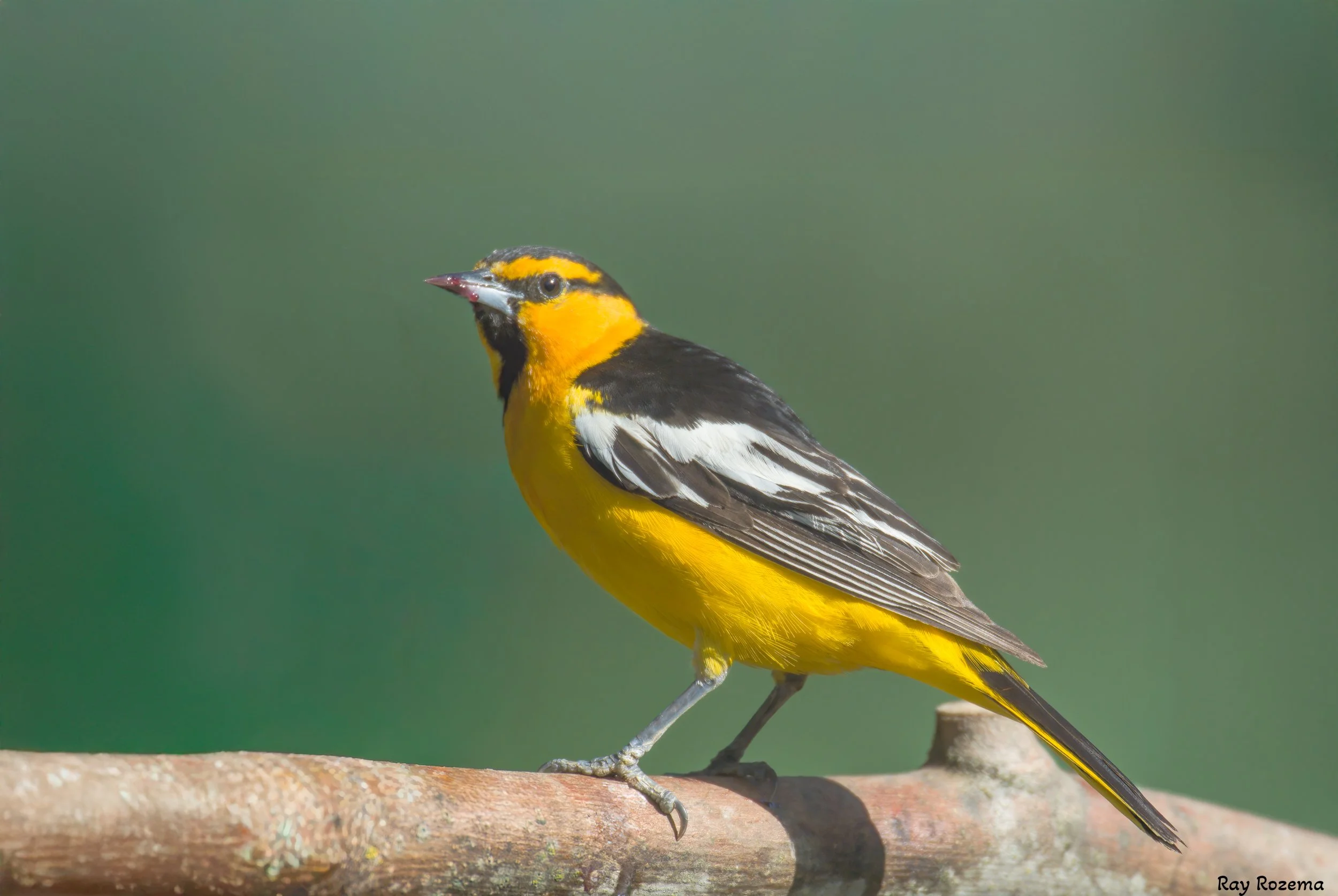
Adult male Bullock’s Oriole © Ray Rozema
What do Bullock’s Orioles sound like?
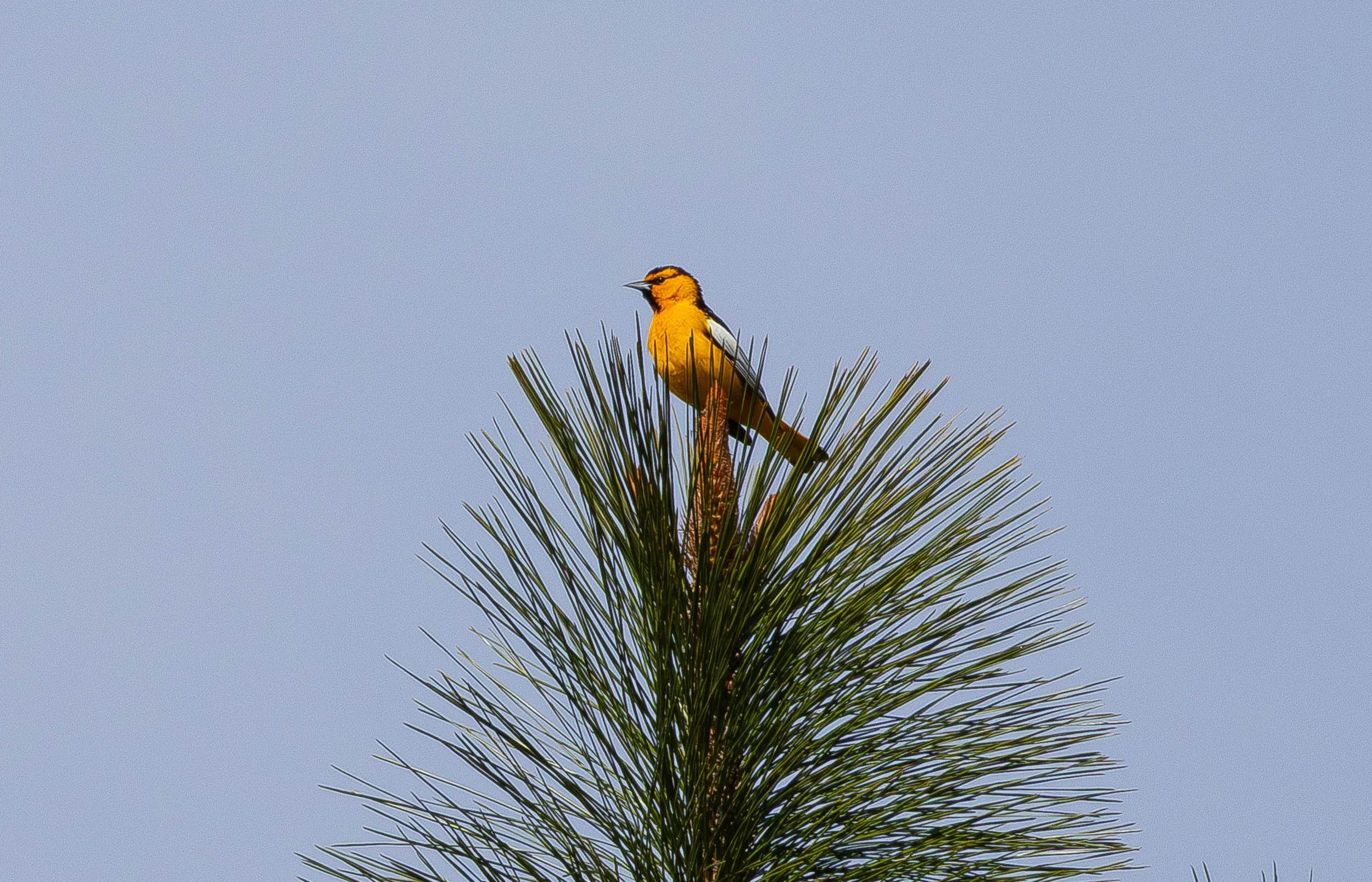
Adult male Bullock’s Oriole © Larry Hickey
Bullock’s Orioles are considered to be very vocal birds and often sing from tall riparian trees or call during flight. Listen for their whistling, chuckling song in tall trees along rivers and streams. Their unique and variable songs often will cause one to pause and listen. Sometimes they make a chattering sound as they take flight; and this call can help you locate them.
The song of Bullock’s Orioles is usually a rapidly changing mixture of harsh chattering, squeaks, creaks, and sweet flute-like whistles. Some describe their song to be similar to the sound of a squeaky toy. Both male and female Bullock’s Orioles sing. It has been found that the female of a pair is often the one that’s singing very close to the nesting site. The males’ songs have been described as being sweeter than the females’.
One call of Bullock’s Orioles is a rough chatter or scolding rattle. It is used to communicate with the family unit, to defend territory, or as an alarm call. They also have a low chirp that’s a single note “wheet”, “chet”, or “check” call. Their flight call is a rising nasal “wreent” or a harsh chattery rattle.
Listen to the Bullock’s Oriole below:
This article was compiled by Jane Van Kessel.
Sources include Cornell’s All About Birds, Cornell’s Bird of the World, National Audubon Society’s Online Field Guide, 150 Frequently Seen Birds of California’s Great Valley, pages 282-3, Animal Diversity Web , National Geographic Field Guide to the Birds of the United States and Canada, West, 2nd Edition, pages 416-17, Sibley Birds West (Field Guide to Birds of Western North America) by David Allen Sibley, 2nd Edition, page 441, Kaufman Field Guide to Birds of North America, Kenn Kaufman, pages 340-1, The Stokes Field Guide to the Birds of North America, 2010, page 734, Peterson Field Guide to Birds of Western North America, Roger Tory Peterson, Fifth Edition, pages 368-9.