
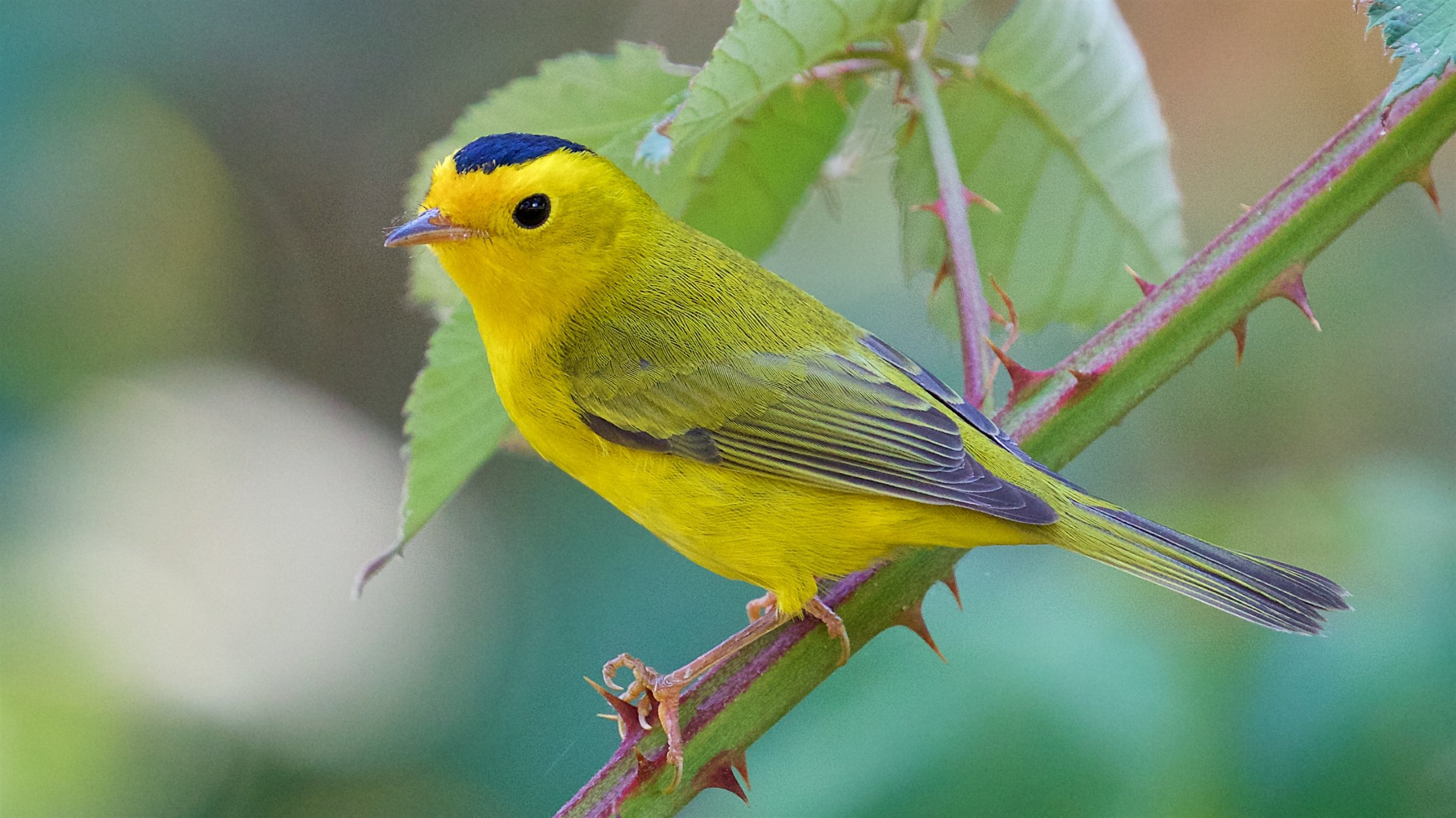
Adult Male Wilson’s Warbler © Ed Harper
This month let’s learn about another interesting bird species, the Wilson’s Warbler (Cardellina pusilla). Wilson’s Warblers are brightly colored songbirds named after Alexander Wilson who came to America in 1794 from Scotland. Wilson was an ornithologist and was the first to describe the species in 1811. The Wilson’s Warbler is one of the smallest warblers found in the U.S. and also can be one of the easiest warblers to identify. Here in the Sacramento Valley, Wilson’s Warblers are seen when they pass through the area during their spring and fall migrations. For some Wilson’s Warbler populations, the distance can be quite a long one: flying from their tropical wintering grounds to the upper regions of North America and back again after their nesting season.
Wilson’s Warblers are in a large group of around 115 species called New World warblers (aka Wood Warblers) which make up the family Parulidae. During migration, New World warblers are the birds seen in the U.S. In contrast, the species of warblers found in Europe are called Old World warblers (Family Sylviidae). Old World Warblers are not closely related to New World warblers. However, the birds in both families have at least one thing in common: they sing pleasant songs.
Wilson’s Warblers are extremely active birds, moving about almost constantly. In addition, they often are seen raising or flipping their tails back and forth and spreading their wings. “Hyperactivity” is a behavior trait common among warblers, but it’s been documented that Wilson’s Warblers are one of the most active warblers. With all this movement it can be a challenge to get a glimpse of one, especially since they are frequently hidden by foliage.
Many warbler species migrate to either the western or to the eastern part of the U.S. However, Wilson's Warblers are one of the few warblers found in every state in the lower 48. Scientists have named 3 subspecies of Wilson’s Warblers (based on plumage color, the size of a darkened area on their heads, and body size). However, some think there may be as many as 6 subspecies and that each of these 6 potential subspecies spend its winter in a different location.
The widespread population of Wilson's Warblers has been declining. The species is currently still considered common; but their numbers have dropped significantly due to the loss of riparian habitat in the West, chemicals used to clear brush, collisions with man-made structures, etc. You can help by planting a native plant garden in your yard. Native gardens attract native insects that wild birds such as Wilson's Warblers like to eat.
What do Wilson’s Warblers look like?
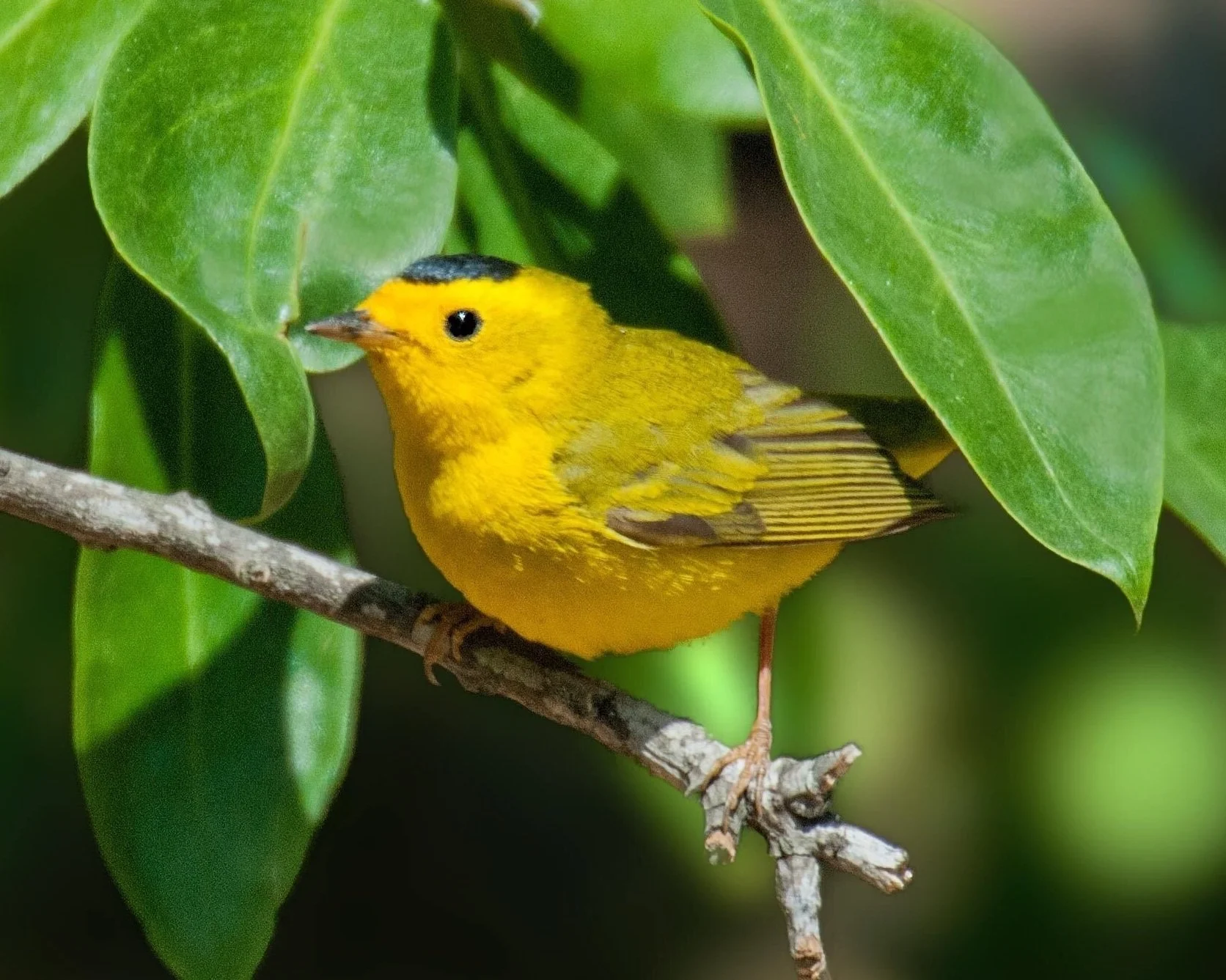
Adult Male Wilson’s Warbler © Ray Rozema
A quick way to identify male Wilson’s Warblers is the visible black cap on top of their heads or crowns. The caps on females can be fainter, smaller, olive-colored, or absent entirely. Wilson’s Warblers are about 4-5 inches long and have unmarked, golden yellow chests and bellies, small, thin, and pointed bills, large black eyes, rounded bellies, thin, orange legs, plain, brownish olive-green backs and wings, long, slender tails without wing bars, thick necks, blocky heads, and solid, dark undertails that continue to the tip of their tails. Another key ID point is that Wilson’s Warblers have a distinctive yellow eyebrow area which contrasts with their darker head and cheek color. Juveniles, as well as females, typically have an olive-green or brownish crown and frequently can be duller overall.
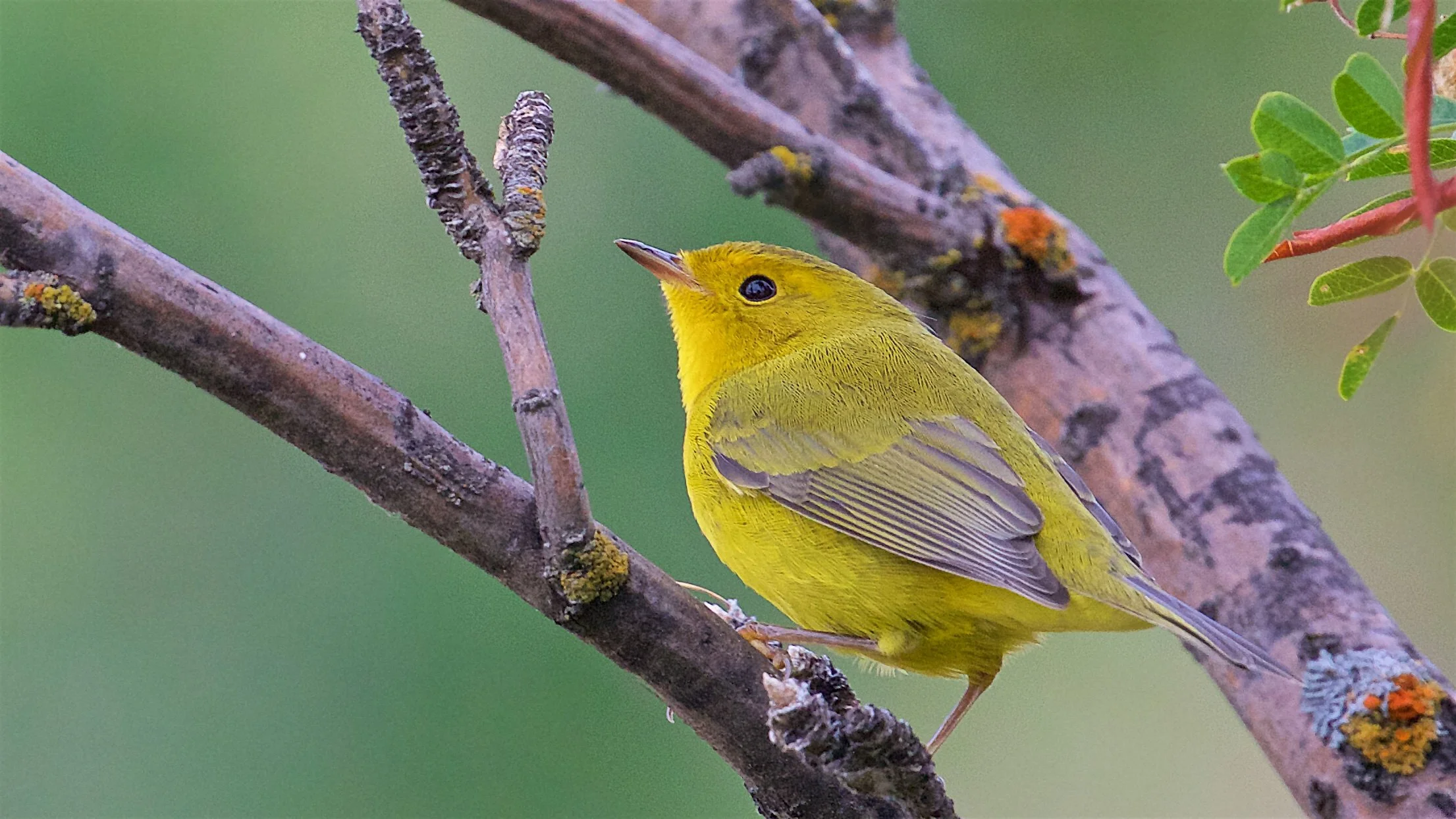
Female Wilson’s Warbler © Ed Harper
Sometimes, it can be tricky to tell Wilson’s Warblers apart from a similar species called the Northern Yellow Warbler. Northern Yellow Warblers lack the dark cap or crown area, often have thin rusty vertical streaks on their breasts, long thick bills, smooth or rounded heads, their necks do not appear thick nor do their bellies appear rounded, have a more pronounced yellow edging on their wing feathers, and have yellow undertail areas that continue to the tail tip. Also, the heads and faces of Yellow Warblers are completely yellow; lacking the contrasting yellow eyebrow area like on Wilson’s Warblers.
Where do Wilson’s Warblers live and nest?
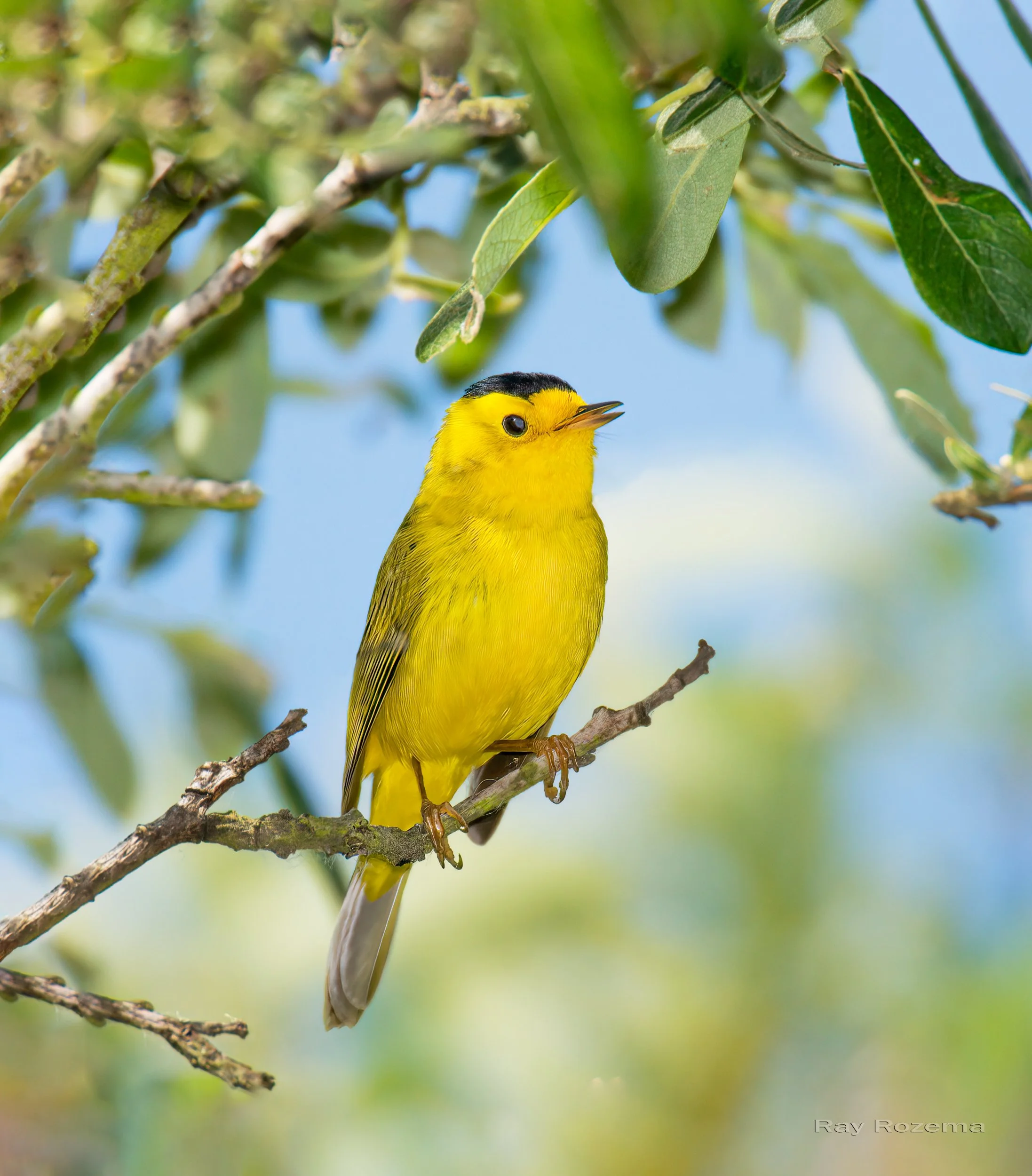
Adult Male Wilson’s Warbler © Ray Rozema
Most populations of Wilson’s Warblers spend their winters in various habitats in Central America, Mexico, and Baja California, where they either have specific territories or form into foraging flocks. A few spend their winters in southern Texas or Louisiana along the Gulf Coast.
In the spring, Wilson’s Warblers migrate to their nesting grounds, which are usually below the timberline. They spend their breeding season in Canada, Alaska, Newfoundland, the coastal mountain regions of California, Oregon, and Washington, the mountains of the Sierra Nevada, and the Rocky Mountain states. Wilson’s Warblers are seen around young conifers, maple, coyote bush, blackberry, oaks, alders, and/or willows.
Wilson’s Warblers seek a moist and cool understory in mountainous, open-forested, and/or riparian habitat for nesting. They are not usually found inside a dense forest interior. Instead, they are seen in wet meadows, thickets, low shrubs, and along brushy woodland edges.
Wilson’s Warbler pairs usually remain together for one breeding season. Male Wilson’s Warblers choose the nesting territories and will attempt to scare or distract predators away by lowering their wings, uttering harsh calls, raising their tails, or by performing a broken wing display. Females build the nests and they are usually located near a base of a tree or shrub, on or near the ground, and close to a water source. The populations of Wilson’s Warblers that build their nests along the Pacific Coast are exceptions and position their nests slightly higher at around 3-5 feet. The nests are cup-shaped and made using leaves, moss, and rootlets and sometimes are lined with fine grass and hair. They are well hidden: either surrounded by moss or dense grass on the ground or inside tangled thickets. Females also perform all (or most) of the incubation; but both parents feed the young. Nestlings begin to leave the nest when they are 8-13 days old. Parents continue to care for the fledglings for a few weeks. Brown-headed Cowbirds have been known to place their own eggs inside Wilson’s Warblers’ nests so that their brood will benefit from both incubation and later feeding. This phenomenon occurs more often in western populations and is called parasitic brooding.
What do Wilson’s Warblers eat?
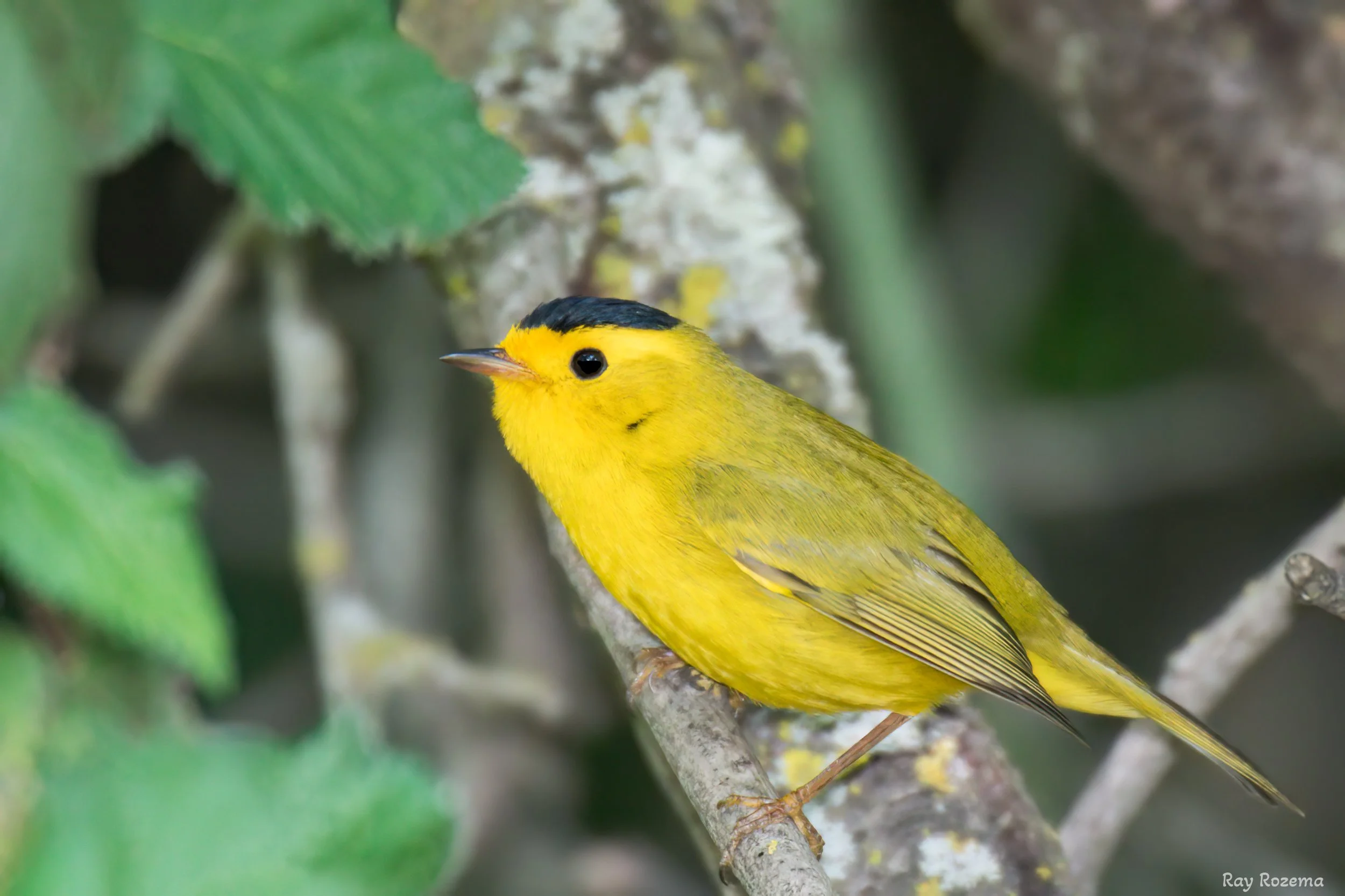
Adult Male Wilson’s Warbler © Ray Rozema
Wilson’s Warblers are middle to low elevation foragers and do most of their foraging in the understory of willows, alders, or shrubs. In some areas they hunt close to the ground. Like other warblers, Wilson’s Warblers primarily eat adult and larval insects including caterpillars, aphids, leafhoppers, bees, beetles, wasps, and mayflies. They also eat spiders. Occasionally, they will eat berries in the winter and will snack on the sugary liquid that’s secreted by scale insects. These energetic birds move almost constantly inside trees in search of food to tug off leaves and twigs. Sometimes, they will hover around a tree and remove prey from the outer branches or will flycatch by darting to catch an airborne insect and then return to their previous perch.
What do Wilson’s Warblers sound like?

Wilson’s Warbler, female / immature © Susie Nishio
Although female Wilson's Warblers do occasionally sing, males sing much more often when defending their territory or attempting to attract mates. When females do sing, their songs have been reported as being quite different from the males’ songs.
The calls of Wilson Warblers have been described as a chirp, sharp chip, husky jimp, low flat timp, or zip, a soft chet, or a flat chuff. Their flight call is a tilk or schkwrit.
Their song has been described as a rapid series of chips which drop in pitch at the end, or a clear trill like chi chi chi chi chi chet chet, rapid and thin chattering, and whistling. You can listen to songs and calls of Wilson's Warblers below.
This article was compiled by Jane Van Kessel.
Sources include Cornell’s All About Birds, Cornell’s Birds of the World, National Audubon Society’s Online Field Guide, 150 Frequently Seen Birds of California’s Great Valley, pages 306-7, National Geographic Field Guide to the Birds of the United States and Canada, West, 2nd Edition, pages 442-3, Sibley Birds West (Field Guide to Birds of Western North America) by David Allen Sibley, 2nd Edition, page 388, Kaufman Field Guide to Birds of North America, Kenn Kaufman, page 304, and The Stokes Field Guide to the Birds of North America, 2010, page 636.